

The Key Differences Between Hostinger vs GoDaddy
The main differences between Hostinger and GoDaddy come down to clarity, cost, and customer experience. Hostinger delivers affordable, no-nonsense hosting with a clean interface and upfront pricing. GoDaddy, while a household name, tends to complicate the experience with upsells, hidden costs, and lackluster support.
If you’re after modern tools and solid value, Hostinger makes a much stronger case.
Hostinger Exclusive Deal
Use promo code ‘HOSTSCORE’ to enjoy additional discount. Get up to 77% discount on Hostinger shared plans today > Click here to grab deal
Compare GoDaddy & Hostinger Services
Hostinger

Our Take
Hostinger offers ultra-affordable hosting plans with a clean control panel (hPanel) and consistent uptime. Founded in Lithuania, the company now supports millions of users worldwide and remains especially popular with beginners launching their first websites. The platform includes one-click installers and tools tailored for WordPress and small business sites. While the introductory pricing remains among the lowest in the market, renewal rates have increased in recent cycles and some shared plan features have been adjusted. Overall, Hostinger still provides one of the most accessible and cost-effective ways to get online, but long-term costs now require closer attention.
GoDaddy
Our Take
GoDaddy may be one of the biggest names in web hosting, but size doesn’t equal quality. While the brand is widely recognized, our experience shows that its hosting services are overpriced, limited in features, and packed with upsells. Even for domain registration — once GoDaddy’s core strength — better value and transparency can be found elsewhere at providers. We do not recommend GoDaddy for web hosting or domain services.
For Beginners: Hostinger is Better
Hostinger is simply way more beginner-friendly. Their hPanel interface is modern, intuitive, and designed to guide new users step-by-step. Even better, Hostinger includes useful extras like a website builder, AI writing tools, and SEO assistance in their business-level plans – all for just $3.99/month.
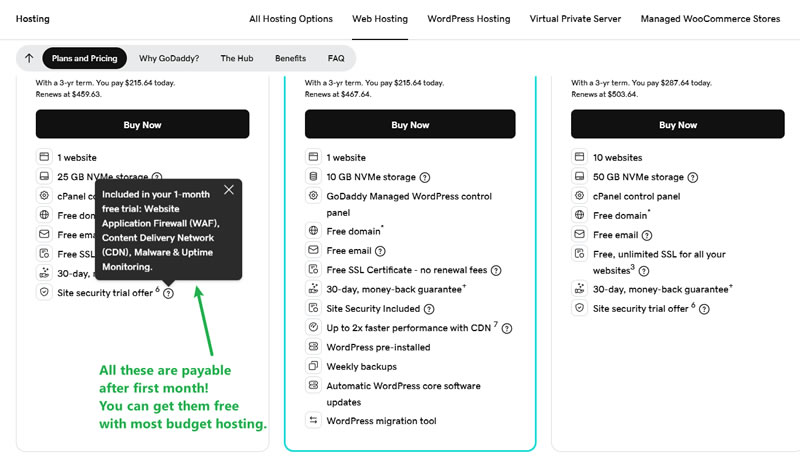
GoDaddy’s interface, while functional, can feel dated and cluttered. Worse, the constant upsells (including after checkout) make it easy for beginners to overspend. Security features like malware scanning and backups are only free for the first month – after that, you’ll be paying almost twice the monthly cost just to keep your site protected.
With Hostinger, most of these essentials are built-in and stay free as long as you’re on the plan. Add their global server presence, free migrations, and excellent onboarding tools, and it’s clear: Hostinger is a better choice for beginners.
| Hosting Type | Hostinger | GoDaddy |
|---|---|---|
| Shared Hosting | $2.99 - 3.79/mo | $5.99 - 54.99/mo |
| VPS Hosting | $6.49 - 25.99/mo | $8.99 - 199.99/mo |
| Dedicated Hosting | $ - /mo | $ - /mo |
| Cloud Hosting | $7.99 - 29.99/mo | $ - /mo |
| Managed WP Hosting | $2.99 - 3.79/mo | $5.99 - 12.99/mo |
| Windows Hosting | $ - /mo | $ - /mo |
| Coupon | HOSTSCORE15 | - |
| Coupon Details | 15% Discount | - |
For WordPress Users: Hostinger is Better

GoDaddy does offer managed hosting for WordPress, but they don’t stack up well against Hostinger’s offerings. Hostinger’s managed WordPress hosting is faster (thanks to NVMe SSDs and LiteSpeed servers), more secure (daily backups + malware scanning), and smarter (built-in AI tools for content and SEO). You’ll also get access to staging environments and object cache on higher plans.
GoDaddy’s WordPress experience, by contrast, feels generic. The performance is mediocre, staging is inconsistent across plans, and you’ll hit paywalls for features you’d expect to be standard.
For serious WordPress users, Hostinger is the better value – and the better performer.
For Freelancers & Small Businesses: Hostinger is Better

When building client sites or managing a small business website, you need hosting that’s affordable, secure, and scalable. Hostinger checks all the boxes: NVMe storage, free domain, SSL, daily backups, unlimited migrations, AI site building tools, wide choices in server locations – all bundled into business-friendly plans that start around $3.99/month.
GoDaddy, on the other hand, costs more but offers less. If you forget to uncheck certain add-ons during checkout, you might end up paying for stuff you don’t need – or worse, find your site missing critical features after the 1-month trial ends.
Bottom line: Hostinger offers a lot more stability and control for freelancers and small business owners, with far fewer hidden costs.
For Power Users: Hostinger is Better

Power users – those running high traffic eCommerce stores, learning platforms, or custom apps—need speed, control, and reliability. Hostinger delivers with its fully NVMe-powered self-managed VPS, cloud, and managed WordPress plans. You also get access to Kodee, their AI assistant for VPS management, plus a well-documented API and global CDN options.
GoDaddy’s VPS is passable, but expensive, and their shared or cloud hosting lacks the advanced options today’s developers want. And when things go wrong? Getting real help from GoDaddy’s fragmented support channels is a challenge in itself.
Hostinger makes scaling easier, development smoother, and troubleshooting faster – which is exactly what power users need.
Verdict
GoDaddy might have brand recognition, but Hostinger delivers far better value, features, and user experience. Whether you’re a beginner launching your first blog or a power user managing multiple VPS instances, Hostinger is the more transparent, reliable, and feature-rich option.
We think GoDaddy just doesn’t hold up in any notable use cases — especially when you factor in pricing tricks and weak customer support.
More About Hostinger & GoDaddy
Hostinger
Hostinger began in 2004 as Hosting Media in Kaunas, Lithuania. The company’s early breakthrough came in 2007 with the launch of 000webhost.com, a free hosting platform that attracted millions of users before being retired. In 2008, it expanded with Hosting24.com, followed by the official launch of the Hostinger brand in 2011.
That same year, Hostinger introduced hPanel, its custom-built control panel designed as a simpler alternative to cPanel. By 2016, the company moved into cloud hosting, offering scalable solutions beyond traditional shared hosting. Growth accelerated quickly — by 2021, Hostinger employed more than 1,000 people worldwide. Today, it operates as a global hosting provider with 10+ international data center locations and a reputation for budget-friendly pricing and continuous product innovation.
Exclusive Hostinger Coupons – Save 10% or 15%!
Use promo code ‘HOSTSCORE’ for 10% off any plan — Or go big with promo code ‘HOSTSCORE15’ on a 4-year plan and unlock 15% off. Longer subscription = bigger savings. Claim Your Hostinger Deal Here!
Hostinger Pros
- Affordable entry plan at $2.99/month for 3 websites, plus 15% off with HOSTSCORE15.
- Global network of data centers in Europe, Asia, North America, and South America
- Excellent AI ecosystem with AI Builder (new!), Hostinger Agent with memory, OpenClaw, Hermes, n8n, and Paperclip
- User-friendly hPanel with API and MCP access for AI-assisted hosting management
- Developer API and MCP integration – Hostinger Connector lets Claude, Cursor, Codex, and other MCP-compatible tools manage websites
- Multiple payment methods accepted, including crypto and digital wallets
Hostinger Cons
- The lowest price requires 48 months upfront and renews at $10.99/month
- Advanced Agent features and managed AI applications may require separate paid plans
- Hostinger AI Builder sites have limited portability compared with WordPress websites
- Hostinger does not support Windows hosting.
GoDaddy
Founded in 1997 by entrepreneur Bob Parsons, GoDaddy emerged as a powerhouse in web hosting and domain registration. Originally known as “Jomax Technologies,” it swiftly rebranded to “GoDaddy” in 1999. GoDaddy’s rise to prominence was fueled by bold marketing campaigns, including memorable Super Bowl ads, solidifying its position as one of the world’s largest domain registrars. Under the leadership of Aman Bhutani, who assumed the CEO role in 2011, the company embarked on global expansion and diversified its product offerings.
In 2015, GoDaddy made history with its IPO debut on the New York Stock Exchange, signaling a new chapter in its journey. Today, GoDaddy continues its trajectory of international expansion, strategic acquisitions, and unwavering support for small businesses, cementing its status as an industry leader.
GoDaddy Pros
- Brand recognition & wide product suite
- User-friendly dashboard (cPanel)
- Global phone support – Local support lines in many countries
GoDaddy Cons
- Aggressive upselling – Many essential features are paywalled or trial-based
- Overpriced domain renewals – .com renewals up to $45/year with $19.99/year WHOIS privacy
- Expensive entry-level plans
- Slow, layered customer support
- Poor value for beginners and small businesses

