

How Are GoDaddy and Cloudways Different?
The main differences between GoDaddy and Cloudways come down to infrastructure, pricing strategy, and how much control you’re given.
GoDaddy relies on traditional shared hosting, which often means limited performance and aggressive upselling. While the entry price may look attractive, essential features like backups, malware protection, and performance boosts usually come with extra costs — especially after the first billing cycle. You’re also working within a tightly controlled environment with minimal server-level access.
Cloudways, on the other hand, is built on a different philosophy. It’s a managed cloud hosting platform that connects you to premium providers like DigitalOcean, Vultr, AWS, and Google Cloud. You get significantly more control over your server environment, access to advanced optimization tools, and a setup tailored for high-performance WordPress, Laravel, or custom apps — without the headache of managing raw infrastructure.
Compare GoDaddy & Cloudways
Cloudways

Our Take
Cloudways delivers managed hosting built on top of major cloud platforms, including DigitalOcean, AWS, Vultr, and Google Cloud. It gives site owners access to cloud-level performance and scaling, but without the burden of handling server administration themselves. The service is geared toward agencies, developers, and fast-growing businesses that need flexibility. That said, Cloudways is not aimed at first-time site owners. Its pricing structure can be harder to follow than traditional shared hosting, and there are no low-cost entry plans. Still, for users who want managed cloud power with advanced features, Cloudways is a strong choice.
GoDaddy
Our Take
GoDaddy may be one of the biggest names in web hosting, but size doesn’t equal quality. While the brand is widely recognized, our experience shows that its hosting services are overpriced, limited in features, and packed with upsells. Even for domain registration — once GoDaddy’s core strength — better value and transparency can be found elsewhere at providers. We do not recommend GoDaddy for web hosting or domain services.
For Cheap Hosting Solution: GoDaddy is Cheaper (But Comes With Strings)
GoDaddy is cheaper — on paper — but it’s not a good value if you care about what’s under the hood.
Their shared hosting starts at $5.99/month, which looks reasonable until you realize backups, malware protection, and even SSL renewal turn into paid features. These costs quickly add up, and the result is a slow, limited environment that’s hard to scale or customize.
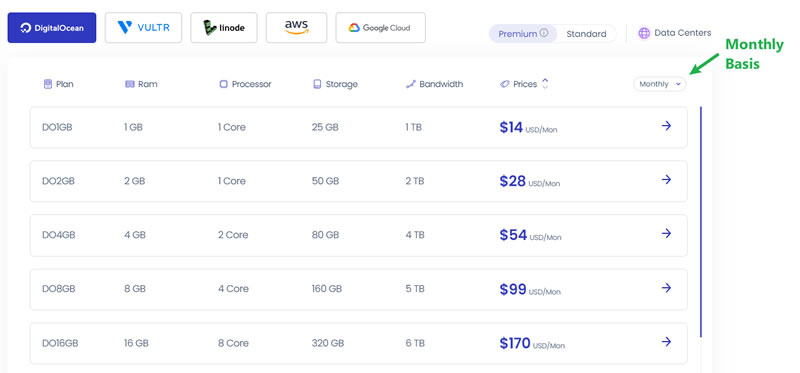
Cloudways, on the other hand, starts around $11/month on the lowest DigitalOcean plan — but you get way more. The platform includes server-level caching, firewalls, staging environments, one-click scaling, and full root access if you need it. No cPanel, no email hosting — but also no bloat or tricks.
If price is your only concern, GoDaddy wins. If you want performance without getting nickel-and-dimed, Cloudways is worth the investment.
| Hosting Type | Cloudways | GoDaddy |
|---|---|---|
| Shared Hosting | $ - /mo | $5.99 - 54.99/mo |
| VPS Hosting | $ - /mo | $8.99 - 199.99/mo |
| Dedicated Hosting | $ - /mo | $ - /mo |
| Cloud Hosting | $11.00 - 1056.00/mo | $ - /mo |
| Managed WP Hosting | $35.00 - 1640.00/mo | $5.99 - 12.99/mo |
| Windows Hosting | $ - /mo | $ - /mo |
| Coupon | HOSTSCORE | - |
| Coupon Details | 30% Discount for 3 Months | - |
For Small Business Hosting & Growing Sites
Cloudways is the smarter pick for small businesses that rely on performance and uptime (who doesn’t?) — especially if their site is central to their marketing or revenue.
You can start small and scale up seamlessly, deploy apps across different cloud providers, and fine-tune performance with tools like Redis, Varnish, and built-in CDN support. The intuitive dashboard is easier to use than many expect, and live chat support is responsive and helpful.
GoDaddy might seem more “small biz friendly” due to its branding, but the actual experience is frustrating. You’ll be locked into limited plans, need to pay extra for basic functionality, and struggle to get helpful support when it matters.
Cloudways gives growing businesses freedom and control, without forcing them into enterprise-level complexity.
For WordPress Users
When it comes to WordPress hosting, Cloudways is in a different league — especially with the introduction of its Autonomous and Flexible hosting plans.
Cloudways Autonomous: Built for Heavy WordPress Workloads

Cloudways Autonomous is a fully managed WordPress hosting solution that runs on isolated containers. This means each WordPress site gets its own dedicated environment with guaranteed resources (RAM, CPU, and storage) — not shared with any other customer. It’s ideal for high-traffic blogs, WooCommerce stores, LMS platforms, or large multisite networks that demand speed and stability under load.
Key features include:
- Autoscaling: Automatically scales up resources during traffic spikes to avoid downtime.
- Built-in CDN & Edge caching: Improves performance by delivering assets closer to the user.
- Advanced caching stack: Varnish, Redis, NGINX, and Memcached come pre-configured.
- Built-in staging environments
- Malware protection & daily backups
- Highly optimized PHP-FPM configurations for WordPress
Autonomous plans eliminate the need to manually fine-tune servers or install complex caching plugins — everything is pre-optimized and containerized for performance.
See
Cloudways Flexible: Best for Developers and Agencies

The Flexible plan, powered by cloud providers like DigitalOcean, Vultr, Linode, AWS, and Google Cloud, gives advanced users full control over server specs, caching, and stack configuration. You can deploy multiple WordPress sites on a single server, use Git integration, set up SSH/SFTP users, and configure cron jobs per app. This makes it ideal for:
- WordPress developers
- Freelancers managing multiple client sites
- Agencies building custom WP solutions
While it’s not as “plug-and-play” as Autonomous, Flexible hosting gives you more control and is more cost-effective at scale.
GoDaddy’s WordPress Hosting: Entry-Level, With Limitations

GoDaddy’s WordPress plans are built for beginners — and they come with many restrictions.
- Only one website is allowed on the base plan.
- “Free” tools like backups and malware scanning become paid add-ons after the first month.
- No staging environment on the entry plan.
- Server performance is shared and non-isolated — leading to slower speeds as traffic grows.
- Limited flexibility — no root access, custom stack changes, or advanced caching layers.
For casual users hosting a basic WordPress blog, GoDaddy might get the job done — temporarily. But for anything beyond the basics — whether it’s running WooCommerce, membership portals, or performance-tuned blogs — you’ll quickly hit walls.
If you run serious WordPress websites or expect to grow over time, Cloudways offers the infrastructure and flexibility to support that growth. With Cloudways Autonomous, you can rest easy knowing your site can handle traffic spikes without crashing. With Cloudways Flexible, you get the power to fine-tune and scale as needed.
GoDaddy, in comparison to Cloudways, doesn’t come close — not in speed, not in features, and certainly not in long-term value.
For Advanced Users

Cloudways is clearly built for developers and advanced users.
You get SSH access, Git integration, custom cron jobs, staging and production environments, server metrics, and the ability to choose your PHP versions, databases, and stack. You’re not stuck with bloatware or vendor lock-in — and you can clone, scale, or migrate apps in minutes.
GoDaddy offers very little in comparison. No root access, limited control, and few developer tools. Even their higher-tier plans are tightly managed and inflexible.
If you need a platform that lets you work the way you want, Cloudways is in another league.
Verdict: Cloudways Crushes GoDaddy in Everything That Matters
When it comes to real-world hosting needs — performance, flexibility, scalability, and control — Cloudways doesn’t just edge out GoDaddy, it completely outclasses it.
Cloudways is built for users who care about speed, uptime, and having the freedom to scale their site without hitting arbitrary limits or surprise paywalls. You get access to top-tier cloud infrastructure (like Linode, AWS, or Google Cloud), advanced features like Object Cache Pro and WP-CLI, and developer-friendly tools that give you total command over your environment.
GoDaddy, on the other hand, feels more like a marketing funnel disguised as hosting. Its shared plans may look budget-friendly, but they’re riddled with upsells and performance trade-offs. Essential features — backups, malware scanning, staging — often require extra fees, and you’re stuck on limited, low-power infrastructure.
If you’re launching a personal blog with minimal traffic and don’t plan to grow, GoDaddy might be enough. But if you’re running WordPress for business, eCommerce, learning platforms, or anything you take seriously — Cloudways is the smarter, faster, and far more future-proof choice.
More About Cloudways & GoDaddy
Cloudways
Established in 2011 by co-founders Aaqib Gadit, Pere Hospital, and Uzair Gadit, Cloudways is a managed hosting platform that initially focused on leveraging partnerships with AWS, Google Cloud Platform, and Digital Ocean to serve its customers better. The acquisition by DigitalOcean in August 2022 further solidified this partnership, enhancing Cloudways’ ability to provide superior managed hosting solutions.
Cloudways Pros
- Reliable server uptime and speed performance
- Good abstration over complex cloud server setups with integrated dashboard
- High scalability; Autonomous plan supports auto-scaling
- Easy server cloning, site staging, and website transfer
- Host unlimited websites and applications in one account
- 30% discount for first two months with coupon “HOSTSCORE”
Cloudways Cons
- Getting expensive – Prices increased steadily for the past few years
- Limited trial period
- Excellent technical support, but poor billing practices and support
GoDaddy

Founded in 1997 by entrepreneur Bob Parsons, GoDaddy emerged as a powerhouse in web hosting and domain registration. Originally known as “Jomax Technologies,” it swiftly rebranded to “GoDaddy” in 1999. GoDaddy’s rise to prominence was fueled by bold marketing campaigns, including memorable Super Bowl ads, solidifying its position as one of the world’s largest domain registrars. Under the leadership of Aman Bhutani, who assumed the CEO role in 2011, the company embarked on global expansion and diversified its product offerings.
In 2015, GoDaddy made history with its IPO debut on the New York Stock Exchange, signaling a new chapter in its journey. Today, GoDaddy continues its trajectory of international expansion, strategic acquisitions, and unwavering support for small businesses, cementing its status as an industry leader.
GoDaddy Pros
- Brand recognition & wide product suite
- User-friendly dashboard (cPanel)
- Global phone support – Local support lines in many countries
GoDaddy Cons
- Aggressive upselling – Many essential features are paywalled or trial-based
- Overpriced domain renewals – .com renewals up to $45/year with $19.99/year WHOIS privacy
- Expensive entry-level plans
- Slow, layered customer support
- Poor value for beginners and small businesses

