

Key Differences Between GoDaddy and SiteGround
GoDaddy and SiteGround both have name recognition, but that’s where the similarities end.
SiteGround offers faster performance, stronger security, and far better support — all built on a modern infrastructure powered by Google Cloud. You get daily backups, advanced caching, and real-time protection included, making it a solid pick for users who care about reliability. That said, their steep renewal rates can sting if you’re on a tight budget.
GoDaddy, on the other hand, hooks you with low entry prices, then hits you with upsells for things like backups, malware scanning, and even domain privacy. Performance is passable, but support is slow and frustrating, especially when you need real help fast.
If you’re choosing between the two, SiteGround is the better long-term bet — just keep an eye on those renewal costs.
Compare GoDaddy & SiteGround Hosting
SiteGround

Our Take
SiteGround offers strong uptime, fast support, and a refined experience tailored to WordPress users. Its platform is easy to use and packed with performance-enhancing features. Although its pricing has gone up a lot over time, SiteGround continues to deliver on reliability and user experience — making it a reasonable pick for small business sites that need dependable performance and hands-on support.
GoDaddy

Our Take
GoDaddy may be one of the biggest names in web hosting, but size doesn’t equal quality. While the brand is widely recognized, our experience shows that its hosting services are overpriced, limited in features, and packed with upsells. Even for domain registration — once GoDaddy’s core strength — better value and transparency can be found elsewhere at providers. We do not recommend GoDaddy for web hosting or domain services.
For Cheap Hosting: Neither is Great
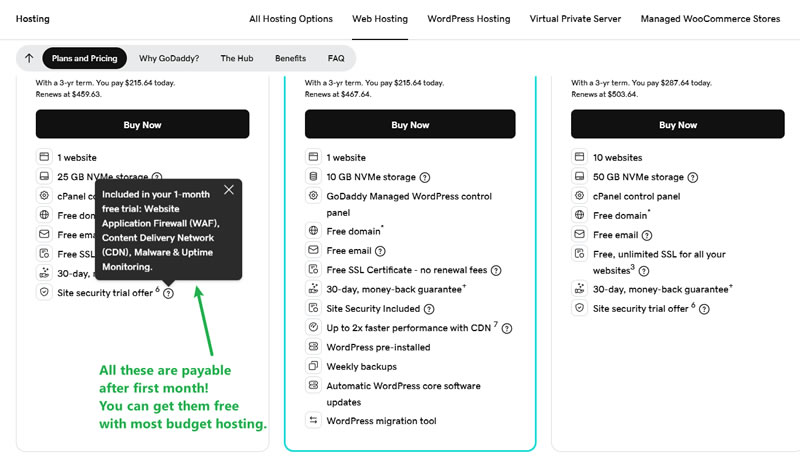

If you’re strictly after low-cost hosting service – neither GoDaddy nor SiteGround is a great long-term solution. But GoDaddy is worse due to hidden charges and a frustrating upsell model.
SiteGround’s startup plan is more expensive upfront and much higher at renewal, but at least the price includes daily backups, security tools, and solid performance. GoDaddy, on the other hand, forces users to pay extra for almost everything — malware scanning, backups, SSL management, and more — and still offers fewer resources.
If you’re on a tight budget, you’re better off skipping both and going with a host like Hostinger or Verpex.
For Small Business Hosting: SiteGround is Better
SiteGround is the better choice for small businesses looking for reliability, uptime, and responsive support.
The platform’s speed, stability, and built-in security tools offer peace of mind for business owners. Their support team is responsive and knowledgeable, and the infrastructure is backed by Google Cloud, which helps keep your site fast and stable under load.
GoDaddy may seem cheaper at first, but the nickel-and-dime pricing model gets expensive quickly. Worse, business users may struggle with the slow, fragmented support experience.
For WordPress Users: SiteGround is Better
SiteGround offers a better WordPress hosting experience compared to GoDaddy.
WordPress sites on SiteGround benefit from features like automatic updates, staging tools, built-in caching (via their SG Optimizer plugin), and strong support from WordPress-savvy agents. Their hosting is well-optimized and secure — all without needing add-on services.
GoDaddy’s WordPress plans are designed to hook new users with freebies that expire after the first month. After that, core features like security and backup become paid extras — and performance is noticeably weaker.
For Advanced Users: SiteGround is Better (With Some Limitations)
SiteGround offers a more developer-friendly environment compared to GoDaddy, but it’s not ideal for everyone.
Advanced users will appreciate SiteGround’s staging tools, Git integration, SSH access, and ability to choose PHP versions. Their managed WordPress stack also provides good control and security. However, users who need full root access or more backend flexibility will find SiteGround limiting — VPS and dedicated hosting aren’t offered (the company offered “Cloud VPS” instead).
GoDaddy fares worse, offering fewer tools and far less transparency. If you need advanced control and server-level flexibility, neither is perfect — but SiteGround gets you closer.
Verdict: SiteGround is the Lesser Evil
Neither GoDaddy nor SiteGround is ideal if you’re focused on price — but SiteGround clearly offers a better hosting product. Despite its painful renewal pricing, it provides stronger security, faster servers, and better support than GoDaddy. If you’re choosing between these two, go with SiteGround — or better yet, look at alternatives.
More About SiteGround & GoDaddy
SiteGround
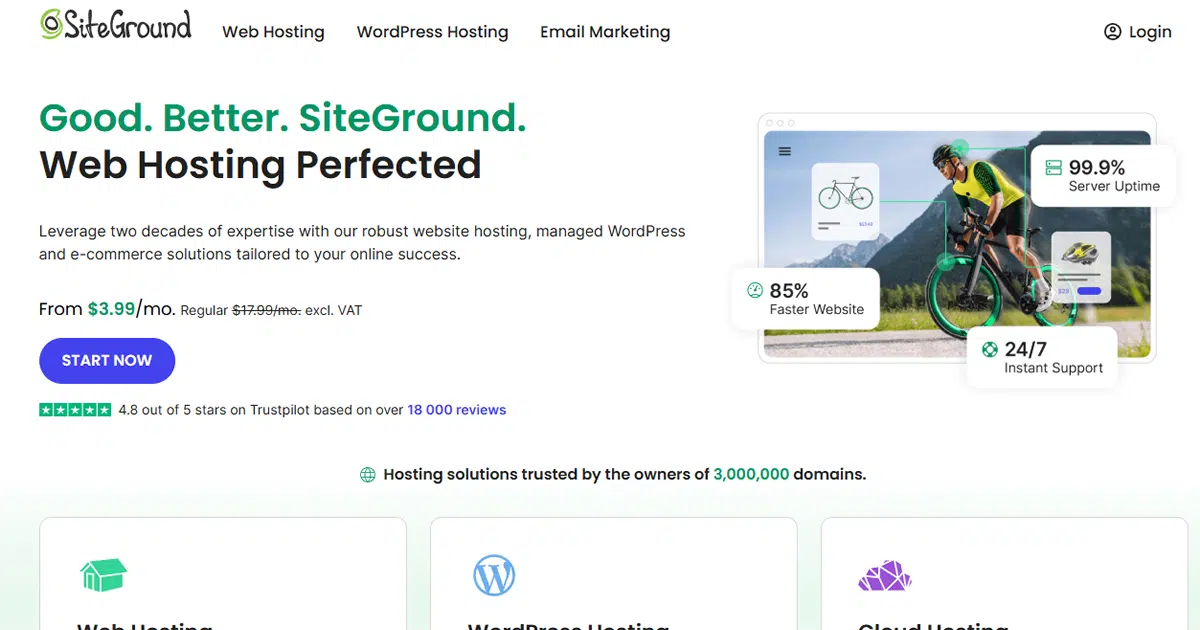
Established in 2004 by a group of university friends led by Ivo Tzenov, SiteGround has flourished into a prominent web hosting entity based in Sofia, Bulgaria. Boasting a workforce exceeding 600 employees, SiteGround proudly hosts almost three millions domains worldwide. With a powerful infrastructure spanning 11 data centers across 8 countries, the company offers an array of hosting solutions including shared, cloud, and enterprise hosting, alongside domain registration services.
SiteGround Pros
- Outstanding hosting uptime and speed performance
- Excellent customer support
- Powered by Google Cloud Platform
- 1-click CDN included in all shared plans
- Specialized WordPress support staff
- Automatic geo-distributed daily backups
- White-label user dashboard and private DNS in GoGeek plans
SiteGround Cons
- Expensive renewal pricing
- Limited storage in shared hosting plans
- Still using traditional SSD instead of NVMe storage
- Staging tool not included in entry-level shared plan
- No Windows Server hosting option
GoDaddy

Founded in 1997 by entrepreneur Bob Parsons, GoDaddy emerged as a powerhouse in web hosting and domain registration. Originally known as “Jomax Technologies,” it swiftly rebranded to “GoDaddy” in 1999. GoDaddy’s rise to prominence was fueled by bold marketing campaigns, including memorable Super Bowl ads, solidifying its position as one of the world’s largest domain registrars. Under the leadership of Aman Bhutani, who assumed the CEO role in 2011, the company embarked on global expansion and diversified its product offerings.
In 2015, GoDaddy made history with its IPO debut on the New York Stock Exchange, signaling a new chapter in its journey. Today, GoDaddy continues its trajectory of international expansion, strategic acquisitions, and unwavering support for small businesses, cementing its status as an industry leader.
GoDaddy Pros
- Brand recognition & wide product suite
- User-friendly dashboard (cPanel)
- Global phone support – Local support lines in many countries
GoDaddy Cons
- Aggressive upselling – Many essential features are paywalled or trial-based
- Overpriced domain renewals – .com renewals up to $45/year with $19.99/year WHOIS privacy
- Expensive entry-level plans
- Slow, layered customer support
- Poor value for beginners and small businesses

