

The main differences between GoDaddy and Verpex lie in their pricing practices, support quality, and overall value for money. While GoDaddy leans on its brand recognition, Verpex wins points with its straightforward pricing, responsive support, and feature-rich plans.
Verpex offers budget-friendly shared and VPS hosting with features like daily backups, unlimited migrations, and a generous 45-day money-back guarantee. They also provide a wide range of server locations and support Windows hosting out of the box.
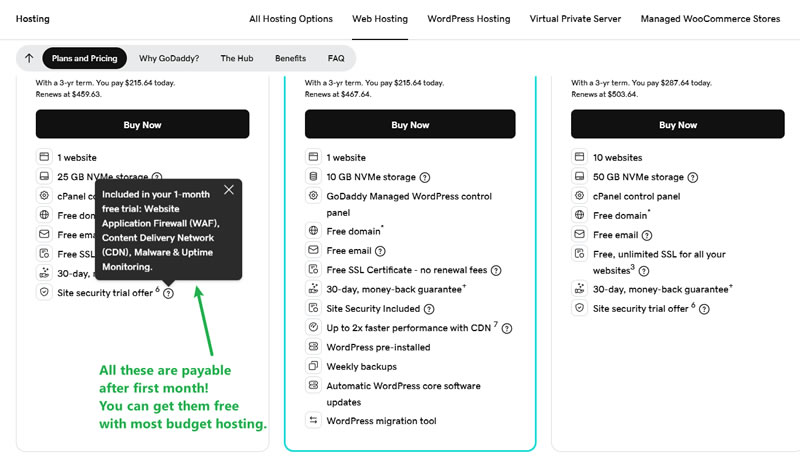
GoDaddy, despite its global reach and familiar brand, falls short in critical areas. Its entry-level plans are overpriced and limited in features. Essential services like malware scanning and firewall protection are only free for the first month — after that, you’ll need to pay extra. Upselling tactics are also aggressive and can easily catch beginners off guard.
Compare GoDaddy & Verpex Services
Verpex

Our Take
Verpex is a fast-growing host that delivers strong global performance, white-label reseller options, and practical features like daily backups and unlimited free migrations. It keeps the setup simple while offering enough power for beginners and small businesses. With plans that cover both personal use and resellers, Verpex offers more value than many hosts in its price range.
GoDaddy
Our Take
GoDaddy may be one of the biggest names in web hosting, but size doesn’t equal quality. While the brand is widely recognized, our experience shows that its hosting services are overpriced, limited in features, and packed with upsells. Even for domain registration — once GoDaddy’s core strength — better value and transparency can be found elsewhere at providers. We do not recommend GoDaddy for web hosting or domain services.
For Cheap Hosting Solution
When it comes to budget hosting, Verpex offers better value than GoDaddy.
At a glance, GoDaddy’s entry-level shared plan starts at $5.99/mo but only supports one website and lacks essential features. Malware scanning and backups are free for just the first month. After that, users must pay an additional monthly fee — something many competitors, including Verpex, offer for free.
Verpex, in contrast, includes daily backups, free site migrations, and global data center options even on its lowest-tier plan. While Verpex does increase its prices at renewal (as most hosts do), the features offered make it a more cost-effective option in the long run.

For Small Business Hosting
Verpex is the better choice for small businesses looking for reliable and affordable hosting.
As we mentioned in our business hosting guide, small business owners need a web host that offers performance, security, and ease of use without hidden charges. Verpex’s plans are transparent and packed with practical features like automated backups, global data center selections, and hands-on support for website migrations. You won’t get hit with surprise upsells for basic security tools.
GoDaddy, on the other hand, often upsells essential features. Support is a hit-or-miss — often involving multiple handoffs before an issue is resolved. These inefficiencies can cost small businesses valuable time and money.

For WordPress Users
Verpex is a better choice for WordPress hosting than GoDaddy – especially if you value reliability and ease of use.
GoDaddy’s WordPress plans are packed with limits. Their “Standard Performance” shared plan supports just one website and lacks many useful tools that other providers include by default. Key WordPress security features and backups become paid add-ons after the first month.
Verpex gives users more out of the box. Daily backups, free SSL, site migrations, and fast support are all part of the deal. Plus, their platform is optimized for WordPress performance with server locations across five continents — helpful for improving site load times worldwide.
For Advanced Users
Both GoDaddy and Verpex offer some flexibility, but neither is ideal for truly advanced users.
Verpex has a slight edge with support for Windows hosting and a cleaner, developer-friendly environment. Their VPS plans are reasonably priced and allow more control for experienced users.
GoDaddy offers Plesk setup, but lacks dedicated hosting and doesn’t advertise Windows-specific plans (we have tried very hard to find the landing page for Windows hosting at GoDaddy.com). Its complex pricing, upsells, and limited transparency make it frustrating for developers who want more control without unexpected charges.
If you’re an advanced user looking for full flexibility and bare-metal customization, you’re better off considering a provider like ScalaHosting, Kinsta (WordPress), or Cloudways.
Verdict: Verpex Wins in Every Practical Way
Verpex wins this comparison by offering more value, better support, and fairer pricing. Their hosting plans are better suited for individuals, small businesses, and WordPress users. GoDaddy, though larger and more recognizable, relies too heavily on upsells and outdated pricing tactics.
More About Verpex & GoDaddy
Verpex
Founded in 2018 by a team with prior ventures later acquired by GoDaddy, Verpex offers cPanel-based cloud hosting with a focus on speed and security. Privately funded and fast-growing, the company now hosts over 300,000 websites on 1,200 servers. Its growth has been driven by competitive pricing, a strong support team, and a customer-first approach that appeals to freelancers, agencies, and small businesses worldwide.
Verpex Pros
- Budget-friendly entry pricing on shared and VPS hosting plans
- 45-day money-back guarantee on shared/reseller plans (longer than industry standard)
- Daily backup included in all shared hosting plans at no extra cost
- Unlimited free site migrations
- Choice of 8 global data centers across five continents
- Wide hosting selection including Windows, reseller, and managed servers
Verpex Cons
- Steep renewal pricing after the first term (up to 90% higher than intro rates)
- Short refund window on managed VPS (7 days compared to 30+ with some competitors)
GoDaddy
Founded in 1997 by entrepreneur Bob Parsons, GoDaddy emerged as a powerhouse in web hosting and domain registration. Originally known as “Jomax Technologies,” it swiftly rebranded to “GoDaddy” in 1999. GoDaddy’s rise to prominence was fueled by bold marketing campaigns, including memorable Super Bowl ads, solidifying its position as one of the world’s largest domain registrars. Under the leadership of Aman Bhutani, who assumed the CEO role in 2011, the company embarked on global expansion and diversified its product offerings.
In 2015, GoDaddy made history with its IPO debut on the New York Stock Exchange, signaling a new chapter in its journey. Today, GoDaddy continues its trajectory of international expansion, strategic acquisitions, and unwavering support for small businesses, cementing its status as an industry leader.
GoDaddy Pros
- Brand recognition & wide product suite
- User-friendly dashboard (cPanel)
- Global phone support – Local support lines in many countries
GoDaddy Cons
- Aggressive upselling – Many essential features are paywalled or trial-based
- Overpriced domain renewals – .com renewals up to $45/year with $19.99/year WHOIS privacy
- Expensive entry-level plans
- Slow, layered customer support
- Poor value for beginners and small businesses

