

A website’s value depends on multiple factors, including its revenue, traffic, and market demand. Knowing how much your website is worth can guide decisions on scaling operations, optimizing monetization strategies, or choosing the right hosting infrastructure to maximize long-term value.
There are several methods to calculate website value, each with varying levels of accuracy. Below, we’ll explore four common website valuation methods and how effective they are.
1. Income Approach
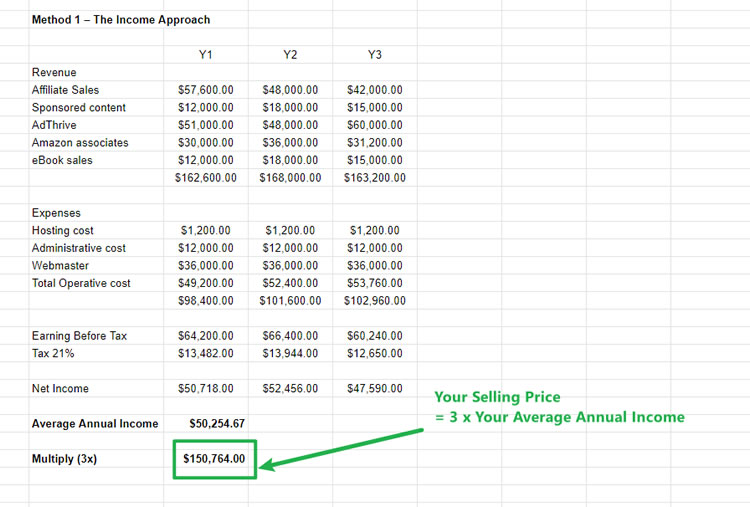
The Income Approach estimates a website’s value based on its future cash flow. This method is useful for business websites generating revenue and can help project return on investment (ROI).
How to Calculate Website Value Using the Income Approach?
To use the Income Approach, follow these steps:
1. Calculate Revenue
Calculate the revenue generated by the website. You can multiply the number of visitors by the average income per visitor or by multiplying the number of page views by the average income per page.
2. Determine Ads Spending
Determine how much money you spend on advertising. This step includes any money spent on search engine optimization (SEO), pay-per-click (PPC) ads, and other forms of advertising.
3. Minus Relevant Costs
Subtract any costs associated with generating revenue from your business. This step needs to include costs related to maintaining your website, such as server hosting fees and technical support fees, and operational costs such as salaries and employee benefits if you have employees working on your website.
4. Add Taxes
Add in any taxes you’ve paid on your earnings from this business endeavor. That includes income taxes and payroll taxes for employees related to the website. You’ll also need to apply sales tax or VAT depending on location.
Once you’ve done all of that, the remaining number is the approximate value of your website. As you can see, it’s a reasonably lengthy process. Because of the vast numbers likely involved, it’s also easy to make mistakes in your valuation when trying to sell your website.
2. Market Approach
The Market Approach values a website by comparing it to similar sites that have recently sold. This method relies on historical sales data and is widely used in website marketplaces.
How to Estimate Website Value with the Market Approach?
- Find Comparable Sales: Look at websites similar to yours in niche, traffic, and revenue.
- Analyze Pricing Trends: Identify patterns in sales prices.
- Apply a Revenue Multiple: Websites typically sell for 20x to 40x their monthly revenue depending on growth potential.
While this approach provides a market-based estimate, it has limitations. No industry-wide standard exists, so the same website may be valued differently by different buyers.
3. Cost Approach

The Cost Approach estimates a website’s value based on how much it would cost to rebuild it from scratch. The Cost Approach works when there are no comparable companies or assets for comparative analysis. You might also use it when the website has changed so much since its last sale that comparing it with more recent sales isn’t helpful because it doesn’t reflect current market conditions well enough.
When to Use the Cost Approach?
- If No Comparable Sites Exist: When a website is unique, making market comparison difficult.
- If Website Design & Development is Expensive: If your website has custom software or proprietary technology.
This approach is less common because buyers typically value a website based on its earnings rather than its creation cost.
4. Website Valuation Tools
For a quick estimate, you can use website valuation tools that analyze traffic, domain age, and revenue. These tools provide an approximate market value but should not be solely relied upon.
Popular Website Valuation Tools
| Tool | Features |
|---|---|
| Flippa AI Tool | Uses AI and machine learning to estimate website value based on past sales data. |
| Empire Flippers Valuation Tool | Estimates value using industry-standard methodologies. |
| Worth of Web | Analyzes website traffic, advertising revenue, and engagement metrics to estimate value. |
| Siteprice.org | Calculates value based on Alexa ranking, estimated traffic, and revenue. |
| GoDaddy Domain Appraisal | Provides domain name valuations based on historical sales and market trends. |
| FE International Valuation Tool | Uses financial modeling to estimate the value of websites with stable revenue. |
| BuySellAds Marketplace Valuation Tool | Estimates ad revenue potential for content-based websites and blogs. |
| Niche Website Builders Valuation Tool | Provides an estimate based on monthly revenue and niche demand. |
| Digital Exits Website Valuation Calculator | Uses a proprietary algorithm to calculate website worth based on profit, traffic, and growth potential. |
While convenient, these tools often overestimate or underestimate value. Use them as a reference, but verify with manual calculations.
Setting up hosting can be confusing. That’s why we created HostScore Setup Help, a done-for-you service for getting your hosting configured the right way.
We help with SSL installation, DNS & nameserver setup, WordPress install or migration, and security tuning. One-time fee. Backed by a 100% refund guarantee.
Explore Our ServicesFinal Thoughts
Which Website Valuation Method is the Most Accurate?
No single valuation method is perfect. The most accurate way to estimate your website’s worth is to combine multiple approaches – analyzing revenue, market comparisons, and growth potential.
If you’re considering selling, marketplaces like Flippa and Empire Flippers can provide real-world sales data to guide your decision. However, if your website earns consistent revenue, calculating its monthly profit multiplier is often the best way to determine its value.
Why Website Valuation Matters for Business Website Hosting?
Understanding your website’s worth is not just about selling – it’s also about making strategic decisions for your business. A high-value website often depends on stability and overall performance – all of which are directly influenced by your web hosting choice.
For business websites, choosing a high-performance hosting provider ensures:
- Faster Load Times – Higher user engagement and SEO benefits
- Uptime & Reliability – Keeps your website operational and valuable
- Scalability – Supports growth, increasing website valuation over time
If your website is an essential business asset, upgrading to the right business hosting solution can boost long-term value. If you’re looking for a hosting provider that can support your site’s growth, revenue, and performance, check out our best business hosting recommendations.

