
A clear sign of a company’s financial success is when it sponsors major sporting events. Since the early 2000s, GoDaddy has been involved in high-profile sports like American football and NASCAR, making its brand a household name. But what exactly fuels GoDaddy’s financial success? How does it continue generating billions in revenue? Let’s take a closer look.
The Evolution of GoDaddy

Founded in 1997 as Jomax Technologies by entrepreneur Bob Parsons, GoDaddy rebranded to its current name in 2006 and has since grown into one of the largest web services providers in the world. While its origins lie in domain registration, the company has expanded far beyond that through both organic growth and strategic acquisitions.
Today, GoDaddy provides services across four main business areas:
- Domain name registration and aftermarket sales
- Web hosting and security solutions
- Website builders and digital marketing tools
- Business applications, including email and productivity software
By diversifying its offerings, GoDaddy has positioned itself as a one-stop shop for individuals and small businesses looking to establish their online presence.
Growth Through Acquisitions
A significant part of GoDaddy’s success stems from strategic acquisitions, allowing it to strengthen its foothold in domains, hosting, and commerce. By acquiring rather than building new products from scratch, GoDaddy has been able to scale quickly and compete more aggressively.
Some notable purchases include
- Afternic and SmartName (September 2013): Acquired to enter the domain parking service business and enhance domain aftermarket capabilities.
- Canary Calendar Service (July 2014): Purchased to integrate smart calendar functionalities into GoDaddy’s offerings.
- Mad Mimi (August 2014): An email marketing service acquired to provide simple and effective email marketing solutions for small businesses.
- FreedomVoice (May 2016): Acquired for $42 million to offer cloud-based VoIP phone systems, expanding GoDaddy’s communication services.
- Host Europe Group (December 2016): Purchased for $1.79 billion, this acquisition expanded GoDaddy’s European hosting services, making it a market leader in Europe for small business cloud services.
- Sucuri (March 2017): A website security company acquired to enhance GoDaddy’s security offerings, providing customers with robust website protection services.
- Poynt (December 2020): Acquired for $365 million, Poynt is a commerce payment solution that enabled GoDaddy to offer integrated payment processing solutions to its customers.
- Dan.com (June 2022): Acquired for an undisclosed amount, Dan.com is a domain trading platform that enhances GoDaddy’s domain aftermarket services by providing a streamlined and secure way for users to buy and sell domain names.
How GoDaddy Makes Money?
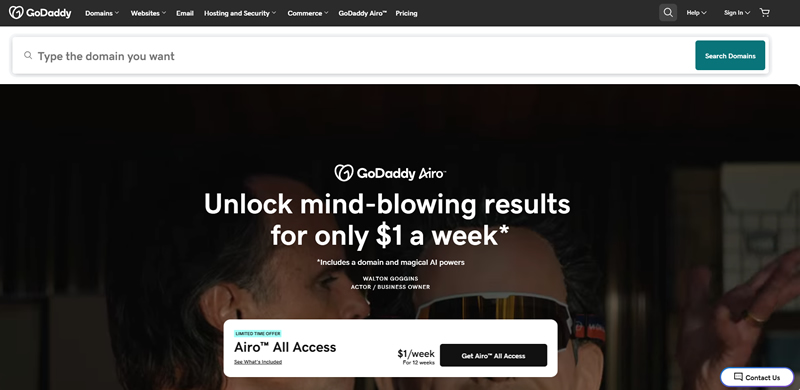
GoDaddy generates revenue through a mix of subscription-based services, premium add-ons, and one-time domain transactions. While it no longer breaks down revenue per category in its reports, historical data suggests that domain-related services account for the largest share, followed by hosting, business applications, and eCommerce tools.
Domain Name Services
As the largest domain registrar in the world, GoDaddy manages over 84 million domains. Its domain revenue comes from new registrations, renewals, premium domain sales, WHOIS privacy protection, and brokerage services.
The acquisitions of Afternic and Dan.com have strengthened its domain aftermarket business, allowing users to trade high-value domains with ease.
Web Hosting and Security Solutions
GoDaddy provides shared hosting, VPS, dedicated servers, and managed WordPress hosting. A significant portion of its hosting revenue comes from upselling essential add-ons like SSL certificates, website backups, and advanced security tools. The acquisition of Sucuri in 2017 further enhanced its security offerings, helping GoDaddy cater to businesses that need malware protection and performance optimization.
Business Applications and Productivity Tools
GoDaddy offers email hosting, business phone systems, and productivity tools as part of its growing suite of business applications. Its partnership with Microsoft 365 enables customers to purchase professional email services, while the acquisition of FreedomVoice introduced VoIP solutions to its portfolio. In recent years, GoDaddy has pushed further into eCommerce solutions, integrating online store features and POS systems through its Poynt acquisition.
Digital Marketing and Website Building Tools
To help small businesses establish their online presence, GoDaddy provides an AI-powered website builder, SEO tools, social media management, and email marketing services. The GoDaddy Airo® platform, launched recently, offers automated website creation and digital marketing features designed to make online business management more accessible for non-technical users.
Financial Performance and Growth Trends

GoDaddy has consistently demonstrated strong financial performance, with revenue growing year over year. In 2024, the company reported $4.6 billion in revenue, an 8% increase from the previous year. This growth was largely driven by its Applications & Commerce (A&C) segment, which includes website-building tools, online stores, and payment processing services.
The Core Platform segment, which includes domains and hosting, generated $2.9 billion in revenue, growing at a slower pace of 3% year-over-year. In contrast, the Applications & Commerce segment grew by 16%, reaching $1.7 billion, reflecting the increasing demand for eCommerce solutions and AI-driven automation.
Another major growth area has been GoDaddy Payments, where transaction volume reached $2.6 billion in 2024, a 55% increase from the previous year. This expansion into digital payments is positioning GoDaddy as more than just a domain and hosting provider—it’s now competing in the broader eCommerce and merchant services space.
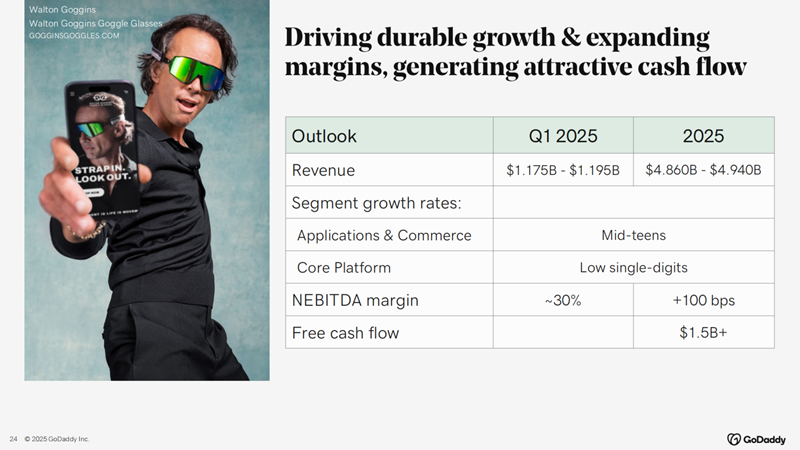
With $1.4 billion in free cash flow and a 31% EBITDA margin, GoDaddy remains highly profitable. Looking ahead, the company plans to expand its AI-driven services, optimize customer retention strategies, and enhance its eCommerce offerings.
Who Are GoDaddy’s Competitors?
Despite its dominance, GoDaddy faces competition from specialized providers in different segments. GoDaddy’s key advantage is convenience – it offers domains, hosting, website builders, and business tools in one place. However, specialized competitors often deliver better individual features, pricing, or performance.
| Business Area | GoDaddy’s Offering | Key Competitors | Competitive Edge of Alternatives |
|---|---|---|---|
| Domain Registration | Largest domain registrar, premium aftermarket sales, domain privacy | Namecheap, Dynadot, Porkbun, Google Domains (Squarespace Domains) | Lower pricing, free WHOIS privacy, simpler domain management |
| Web Hosting | Shared, VPS, dedicated hosting, Managed WordPress | Hostinger, Verpex, Cloudways, Kinsta | Faster performance, better customer support, fewer upsells |
| Website Builders | GoDaddy Website Builder, Managed WordPress, GoDaddy Airo® | Webflow, Wix, Weebly, WordPress.com, Shopify | More design flexibility, better features for eCommerce and blogging |
| eCommerce & Payments | GoDaddy Payments, Poynt POS, online store builder | Shopify, WooCommerce, BigCommerce, Stripe, Square | More advanced selling tools, better integrations |
| Email & Business Apps | Microsoft 365 email hosting, webmail, FreedomVoice (VoIP) | Google Workspace, Zoho, ProtonMail, Rackspace | Better security, more integrations, flexible pricing |
| Digital Marketing Tools | SEO tools, social media management, email marketing (Mad Mimi) | Mailchimp, HubSpot, Ahref, Constant Contact, SEMrush | More powerful automation, better analytics, broader integrations |
Should You Consider GoDaddy as an Investment?
Disclaimer: We are not financial advisors, and this section is not intended as financial advice. At HostScore.net, our expertise lies in web hosting, domains, and digital services—not investment strategies. If you’re considering investing in GoDaddy, we strongly recommend doing your own research and consulting a licensed financial professional.
That said, GoDaddy presents an attractive investment case due to its steady revenue growth, high-margin services, and strong free cash flow. The company’s focus on AI-driven automation and eCommerce solutions positions it well for future expansion.
However, investors should consider competition pressure, pricing sensitivity, and GoDaddy’s $2.8 billion debt load when evaluating its long-term prospects.
Is GoDaddy the Right Choice for You?

For individuals and businesses looking for an all-in-one solution, GoDaddy offers domains, hosting, website builders, and marketing tools in one place. It’s an ideal choice for those who prioritize convenience and ease of use. However – to be completely frank – we recommend those looking for higher performance, better customer support, or lower costs may find better alternatives with specialized providers.
Learn more in our review on GoDaddy performance as a hosting provider here.
Wrapping Up
GoDaddy has evolved into more than just a domain registrar, now offering a wide range of digital services for small businesses. With recurring subscription revenue, AI-driven automation, and a growing focus on eCommerce, it remains a major player in the industry.
That said, competition is fierce, and users should carefully evaluate whether GoDaddy’s convenience outweighs potential downsides like pricing and upselling.
At HostScore.net, we focus on helping users compare web hosting and domain services based on performance, value, and real-world usage. Whether GoDaddy is the right choice depends on your specific needs – and that’s where detailed comparisons and hosting reviews come in handy.

