

What Is a Data Center and Why It Matters for Web Hosting?
A data center is a facility that physically stores and powers the servers behind your web hosting. These buildings are where your website’s files, databases, and applications actually live and get served to users around the world. For hosting buyers, understanding data centers helps you evaluate uptime, speed, and compliance claims made by hosting companies.
What Defines a Data Center in Hosting?
A data center hosts servers, storage systems, and networking equipment used by web hosting companies. These centers provide regulated environments with backup power, cooling systems, physical access controls, and security protocols.
Hosting providers select data centers based on reliability, infrastructure quality, and connectivity. High-grade data centers are often certified by the Uptime Institute and come with redundant systems for power, cooling, and connectivity.
How Data Centers Work for Web Hosting?
When you buy hosting, your website is deployed to a server inside a data center. That server stores your files and delivers them when users visit your site.
Data centers connect to the global Internet through multiple upstream providers. Internally, they use routers, firewalls, and load balancers to manage traffic and prevent outages. Hosting providers either operate their own data centers or lease space (colocation) in third-party facilities.
Understanding how data centers serve your website is only one piece of the puzzle. Where those data centers are physically located also plays a big role in how your site performs for global or regional audiences.
Why Data Center Location Impacts Hosting Performance?
Server location affects how quickly your website responds to visitors. A shorter physical distance between your users and the data center reduces latency. For example, a website hosted in Singapore will likely load faster for Southeast Asian users than one hosted in Europe.
Even with a CDN that delivers static content closer to users, dynamic elements like logins, searches, or eCommerce transactions still rely on the data center. That’s why location still matters for WordPress, WooCommerce, LMS, and forum sites.
Beyond location, not all data centers are built the same. Their internal infrastructure — redundancy, power, cooling — directly affects how reliable and secure your hosting can be. That’s where data center tier classifications come in.
Comparing Data Centers Tier Levels and Certifications
Data centers are categorized by tiers from I to IV, based on infrastructure redundancy:
| Tier | Redundancy | Typical Use Case |
|---|---|---|
| Tier I | No redundancy | Development or hobby sites |
| Tier II | Some redundancy | Small business hosting |
| Tier III | Concurrent maintainability | Standard for high uptime sites |
| Tier IV | Fully fault-tolerant | Financial, healthcare, enterprise workloads |
Hosting providers often disclose data center tiers in their specs. Tier III and IV are preferred for uptime-sensitive or compliance-driven sites.
Knowing the tier level gives you a baseline for reliability. But to make smarter hosting decisions, it’s worth digging deeper into what these high-tier facilities actually offer and what trade-offs they may bring.
Data Center Features and Trade-Offs
Key Infrastructure Features
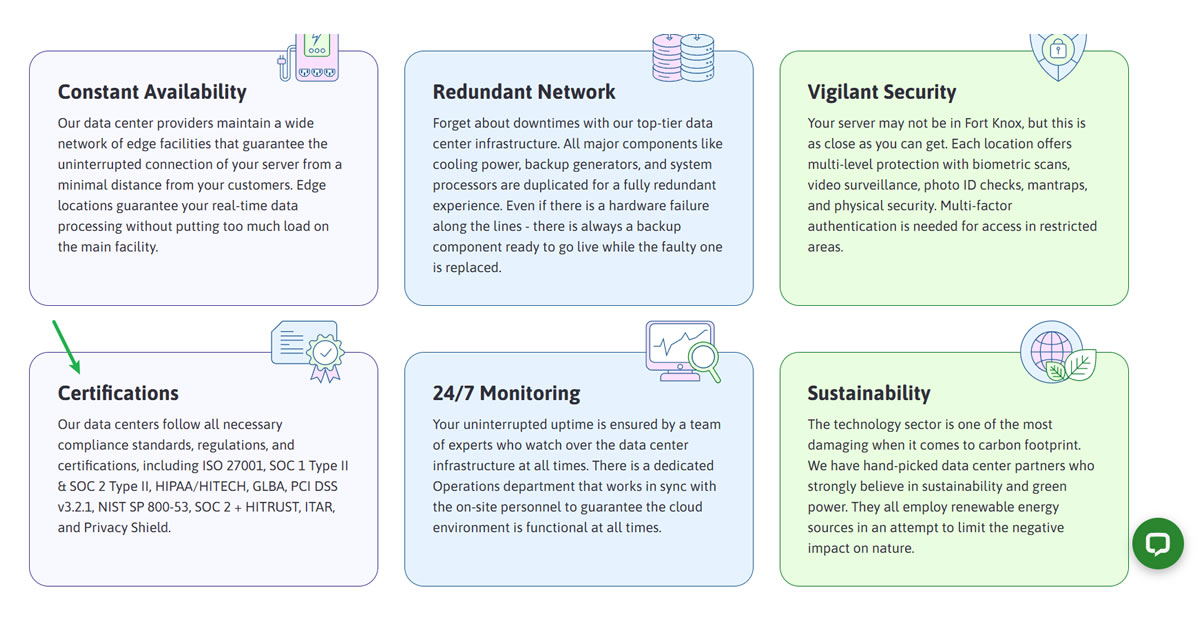
High-tier data centers are engineered to keep your site online under virtually any condition. These facilities often include redundant power (N+1 or 2N), industrial cooling systems, and multi-layered physical security such as biometric access controls and 24/7 surveillance. Advanced climate systems regulate airflow and temperature to extend hardware lifespan, while real-time monitoring helps detect and resolve issues before they escalate.
All of these features work together to reduce single points of failure. For hosting customers, that translates into fewer outages, better uptime scores, and infrastructure that’s compliant with standards like HIPAA, PCI DSS, and GDPR. This level of stability is especially important if you’re running mission-critical applications, storing personal data, or serving users at scale.
That said, reliability comes at a cost. Premium data centers are expensive to operate, and those expenses often show up in hosting plan pricing. You may also encounter limitations in how much you can customize the server hardware, as these environments are typically optimized for standardized, high-efficiency deployments.
Pros and Cons of High-Tier Facilities
In short, high-tier data centers offer peace of mind but not every project needs that level of protection. For development sites, hobby blogs, or low-traffic projects, lower-tier options may be perfectly acceptable and more budget-friendly.
| Pros | Cons |
| Fewer outages due to redundant infrastructure | Higher hosting costs due to facility overhead |
| Enhanced physical and network security | May restrict custom server configurations |
| Suitable for HIPAA, PCI DSS, or GDPR compliance |
Which Hosting Providers Use Premium Data Centers?
Not all web hosts operate their own data centers. In fact, many hosting companies lease space from colocation providers or partner with global cloud platforms. However, several brands stand out for offering hosting that runs exclusively on high-tier infrastructure.

Kinsta, for example, builds its entire platform on Google Cloud’s C2 and Premium Tier network. Every site deployed through Kinsta runs on infrastructure equivalent to Tier IV standards, with redundancy and failover built into every layer. Similarly, WP Engine uses a multi-cloud approach with both Google Cloud and AWS to provide high-availability WordPress hosting across several geographic regions.

SiteGround also relies on Google Cloud, giving users access to a redundant global network with fast regional delivery. In the cloud hosting space, providers like DigitalOcean and Kamatera operate their own Tier III+ data centers, offering greater control over hardware provisioning and performance tuning.
For an in-depth breakdown of which brands use what kind of infrastructure, visit HostScore’s hosting reviews
How Data Centers Affect Hosting Costs and Scaling?
The type of facility a host uses (plus how they manage server resources) has direct implications on both your monthly bill and your ability to scale over time. That’s why it’s worth understanding how data center choices shape the economics and flexibility of different hosting plans.
Data centers represent one of the largest costs in hosting operations. Providers using high-tier infrastructure usually charge more for plans with higher uptime guarantees and better performance.
Cloud and VPS providers scale server capacity across multiple data centers. This horizontal scaling allows them to allocate more CPU, RAM, or storage without hardware migration. Traditional shared hosting may be limited to single-location deployment.
When Does Data Center Choice Matter?
So, when does all this actually matter? While it’s tempting to focus only on features and pricing, your choice of host, and by extension – their data center, can significantly impact your site’s stability, compliance posture, and user experience.
You should care about data center quality and location if:
- Your site handles eCommerce transactions or stores personal data
- You serve users in a specific region or country
- You need to meet compliance standards like GDPR, HIPAA, or PCI
- You run forums, LMS, or dynamic applications with real-time activity
For personal projects or testing environments, Tier I or II data centers may suffice and help reduce costs.
Conclusion: Data Centers Shape Your Hosting Experience
A data center is the foundation of your web hosting service. Its location, tier level, and infrastructure directly affect your site’s speed, availability, and scalability. Choose a host that aligns with your performance or compliance needs and always check where your site will be deployed.
To explore which providers offer premium data centers or regional options, visit our best web hosting selections.

