When launching a website, most people obsess over features like themes, plugins, or even logo design — but often overlook one of the most foundational decisions: Where should you host your website?
We’re not just talking about which hosting provider to use, but rather where your hosting server physically lives and whether it aligns with your target audience.
Does your site serve local users in one country? Are your readers spread across continents? Are there legal considerations tied to data storage? Your hosting geography can influence everything from site speed to SEO performance, support accessibility, and even compliance with local laws.
This article will help you understand:
- What it really means to choose between global and local hosting
- How this choice affects performance, search rankings, and more
- Common use cases that illustrate which strategy works best
- Whether a hybrid hosting approach might be your sweet spot
We’ll also point you toward relevant country-specific hosting guides to help you make a more tailored decision.
What’s the Difference Between Local and Global Hosting?
Choosing between global and local hosting is about making a strategic decision based on who your website is built for. The difference lies not in the features offered, but in how those features align with your audience’s geography, expectations, and specific personal needs.
What Is Global Hosting?
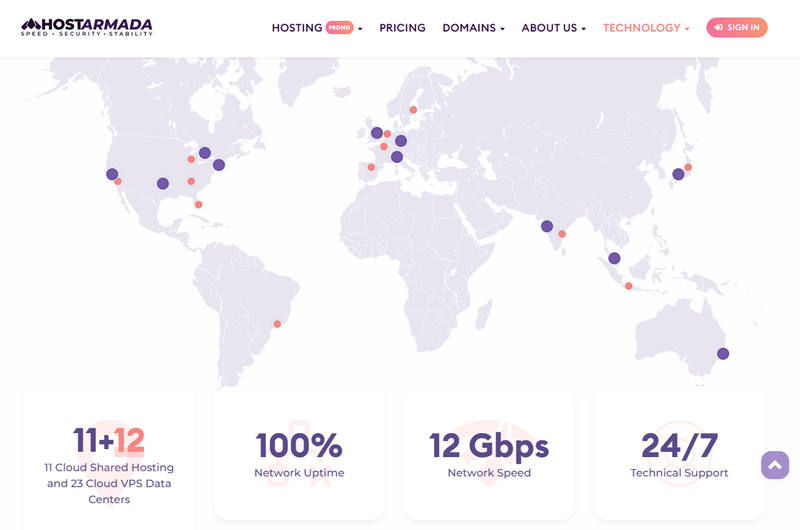
A global hosting provider typically maintains data centers across several continents or integrates with content delivery networks (CDNs) to distribute site content closer to users worldwide. These web hosts are designed to serve international audiences efficiently, regardless of where the website owner is located. Many of our favorite hosting providers, including Hostinger, HostArmada, ScalaHosting, Cloudways, Kamatera, and Kinsta, fall into this category. Their infrastructure is built for scalability, distributed performance, and cross-border flexibility. Global hosts are well-suited for blogs, SaaS platforms, and eCommerce businesses that target users across multiple countries.
What Is Local Hosting?

In contrast, local hosting providers focus on delivering optimal performance within a specific country or region. They often host data on domestic servers, offer support in the local language, and tailor their services to meet regional legal and financial requirements. This approach is ideal for businesses that primarily serve customers in one location — such as local retailers, government contractors, or professional service firms handling sensitive client data.
By choosing a provider that understands the nuances of the local market, website owners can often enjoy better support, faster load times for domestic users, and more straightforward compliance.
While the lines between the two can blur — especially with global providers offering regional data centers — understanding the distinction helps you prioritize what really matters to your project: reach versus proximity.
Five Key Factors to Consider Before Choosing
There are five core factors that typically influence whether a global or local hosting strategy is the right fit: performance, SEO, compliance, support, and billing. Each comes with its own set of trade-offs and practical implications.
1. Performance and Latency
Latency refers to the time it takes for your server to respond to a user’s request. The closer your audience is to your server, the lower the latency and the faster the site loads.
For example, if your website is hosted in London but your audience is primarily in Jakarta, users in Southeast Asia may experience noticeably slower load times.
While global hosts like Hostinger or TMD Hosting minimize this issue by offering geographically distributed servers and integrating with CDNs, local hosting still has the upper hand when every millisecond counts — particularly for mobile-heavy traffic or transactional websites.
2. Compliance and Legal Requirements
As global data privacy concerns grow, many countries now enforce laws that require certain types of personal or sensitive data to be stored within national borders or processed according to local standards. This is especially critical for businesses handling customer data, financial records, or confidential communications.
In many regions, especially if you’re in a regulated industry like healthcare, finance, education, or government, storing data locally or within a trusted jurisdiction isn’t just a best practice — it may be a legal requirement.
Below is a summary of key compliance laws across major regions (and our home country Malaysia), their data localization requirements, and hosting provider suggestions to help businesses stay aligned:
| Region / Country | Key Regulation(s) | Data Localization Requirement |
|---|---|---|
| European Union | GDPR (General Data Protection Regulation) | Not strictly required, but data must be protected to EU standards; many prefer EU-based storage for compliance and latency. |
| California (USA) | CCPA / CPRA (California Consumer Privacy Act / Privacy Rights Act) | No strict localization, but data must be protected and deletion/opt-out requests honored. |
| China | CSL (Cybersecurity Law), PIPL (Personal Information Protection Law) | Yes – Critical data must be stored within mainland China. ICP license often required. |
| India | DPDP Act (Digital Personal Data Protection Act, 2023) | No blanket requirement, but critical data may need to stay within the country under sector-specific rules. |
| Australia | Privacy Act 1988 + Australian Privacy Principles (APPs) | No formal localization, but overseas data transfers must ensure equivalent protection. |
| Brazil | LGPD (Lei Geral de Proteção de Dados) | No strict localization, but cross-border transfers must meet adequacy or contractual safeguards. |
| Malaysia | PDPA (Personal Data Protection Act) | No data residency mandate, but local processing may simplify compliance for sensitive sectors. |
Choosing a hosting provider with regional data center options can help businesses strike the right balance between performance, legal compliance, and customer trust. Global platforms with wide choices of server locations like ScalaHosting, Hostinger, Cloudways (which offers both AWS and Google Cloud infrastructure), Kinsta, and Kamatera allow you to deploy your websites and apps in specific jurisdictions, ensuring that your data stays where it legally should.
3. SEO and Search Visibility
From an SEO perspective, server location doesn’t have as much direct impact as it once did.
Google’s algorithms now consider a range of signals when determining a site’s relevance to a local audience, including the use of country-code top-level domains (like .com.au or .co.uk), hreflang tags, and locally targeted content. However, there is still an indirect link between hosting and SEO: speed and user experience affect bounce rates and engagement, which in turn influence rankings.
A site that loads slowly because it’s hosted far from its primary users can suffer in search performance, even if its content is relevant. In this sense, local hosting can provide an edge for hyper-local SEO efforts, while global hosting remains viable with the right technical setup.
4. Customer Support and Communication (Time Zones, Language)
Support quality is often tied not just to response times, but to cultural understanding, time zones, and communication style. Local hosting providers often:
- Offer support in your native language
- Operate during your working hours
- Understand regional tech norms and expectations
This can lead to faster problem resolution and a better customer experience.
That said, many global hosts, including HostArmada, offer true 24/7 live chat support with fast response times and experienced staff. Whether that support feels responsive and contextual may depend on your specific expectations and the nature of your business.
5. Billing and Currency Considerations
Hosting fees may seem standardized at first glance, but currency and payment methods can create unexpected friction. International providers often charge in US dollars or euros, which can introduce foreign exchange fees or price fluctuations due to market conditions.
Local web hosts tend to bill in local currency, which simplifies budgeting and may even allow for more familiar payment methods like bank transfers, FPX, or regional e-wallets. For small businesses or freelancers, this predictability can be a meaningful operational advantage — especially when scaling up hosting plans or adding services like domain renewals or email accounts.
Use Case Breakdown: Local vs Global Hosting in Practice

With the foundational factors in mind—performance, SEO, compliance, support, and billing—the next logical step is to apply these concepts to real-world situations. Below, we explore how global vs. local hosting decisions play out for different types of websites and businesses. These examples are based on common audience scenarios we see across HostScore.net readers and clients.
Each case highlights how hosting strategy influences user experience, operational efficiency, and long-term growth.
Case #1: A Cafe Chain in Malaysia with a Loyalty App
This business serves customers exclusively within Malaysia. Its website is used to promote seasonal menus, support online orders, and integrate with a mobile loyalty app that offers real-time rewards. Speed and reliability are critical, especially for mobile users accessing the site from different cities. Support in Bahasa Melayu and billing in Malaysian Ringgit are also priorities.
Hosting Recommendation (Local, Global, or Hybrid)
In this case, a local hosting provider like Serverfreak with servers located in Malaysia or Singapore would deliver faster page load times and easier communication. It also simplifies compliance with local data protection regulations (PDPA). While a global host like Hostinger could also work — especially if using a nearby Singapore data center — a local provider may have an edge in terms of latency and culturally aligned support.
Case #2: A Lifestyle Blog Monetized via Affiliate Marketing (Target Audience: US, UK, Australia)
Imagine a solo blogger based in Southeast Asia who writes about fashion, travel, and wellness. The content is written in English and monetized through affiliate programs with global brands. Most of the blog’s traffic comes from search engines and social media platforms in the US, UK, and Australia.
Hosting Recommendation (Local, Global, or Hybrid)
In this scenario, the blogger should prioritize hosting that caters to a geographically dispersed audience. A global provider like HostArmada, which offers multiple server locations in North America, Europe, and Asia, would be a smart fit.
With the help of a built-in CDN, the site’s images and content can be cached and delivered efficiently regardless of user location. Local hosting wouldn’t offer any SEO advantage here and may even reduce performance for overseas visitors.
This use case also shows how even website owners outside their target market can benefit from international hosting infrastructure — proximity to the audience, not the website creator, is what counts.
Case #3: A B2B SaaS Startup Targeting US and EU Businesses
Let’s take the example of a SaaS company based in Eastern Europe but marketing its software to mid-sized businesses in the US and European Union. The web application stores sensitive client data, including billing records and activity logs. Reliability, uptime, and legal compliance are essential, as is maintaining a fast and secure user experience across both continents.
Hosting Recommendation (Local, Global, or Hybrid)
A flexible global provider like Kamatera or Cloudways is ideal here. It offers precise control over server locations, allowing the startup to deploy infrastructure in both the US and Europe while remaining compliant with GDPR and other data protection laws. With access to scalable cloud instances, the business can easily grow its resources as demand increases.
While the startup could explore hosting with a European local provider, the dual-market focus, compliance needs, and technical complexity make a global host with enterprise-grade architecture the more practical long-term choice.
Case #4: A WooCommerce Store Targeting Shoppers in Central Europe
Consider an online store that ships products to customers in Germany, Austria, and surrounding regions. The business runs on WordPress with WooCommerce and handles thousands of monthly visitors. The owner wants fast checkout experiences, strong SEO for German keywords, and solid data privacy protections.
Hosting Recommendation (Local, Global, or Hybrid)
In this case, a regionally optimized host with nearby infrastructure is the best fit. A provider like Kinsta or ScalaHosting, with data centers in Europe and a focus on high-performance WordPress setups, offers the right blend of technical power and geographic proximity. Fast server response times enhance the shopping experience, and regional infrastructure supports GDPR compliance out of the box.
A US-based global host might still provide solid performance if paired with a CDN, but localized infrastructure makes SEO tuning and regulatory alignment easier.
Case #5: A Government-Supported Education Portal in Spain
Let’s say a government agency in Spain is launching an educational platform with online resources for teachers and students nationwide. The site needs to comply with Spanish data laws, offer reliable performance for users across the country, and provide localized support for non-technical administrators.
Hosting Recommendation (Local, Global, or Hybrid)
A local hosting provider such as Webempresa is well-suited here. With servers located in Spain, customer service in Spanish, and a strong reputation for WordPress performance, the company delivers excellent domestic speed and support while staying compliant with national regulations.
Using a global host would introduce unnecessary complexity around compliance, localization, and support. When the audience is entirely domestic and the content highly regulated, local hosting wins on all fronts.
These examples show that hosting strategy isn’t a one-size-fits-all decision. What matters most is understanding where your audience is, what they expect, and what your business needs to deliver a secure, fast, and seamless experience.
Pros & Cons of Global vs. Local Hosting
Now that we’ve explored how global and local hosting perform in real-world contexts, let’s distill the trade-offs into a simple comparison. While each approach has clear strengths, many site owners will find that the best solution lies somewhere in between — a hybrid setup tailored to specific needs.
Pros and Cons of Global Hosting
Pros
- Wider reach: Great for websites with an international audience.
- CDN integration: Often comes with built-in CDN support to optimize global content delivery.
- Scalability: Typically built on cloud or hybrid infrastructure that can handle growth easily.
- Flexible server location choices: Hosts like Hostinger and Kamatera allow you to choose data centers in multiple countries.
- 24/7 support: Global teams mean around-the-clock technical assistance.
Cons
- Potential compliance complexity: May not meet data residency laws without careful configuration.
- Billing issues: Foreign currency billing and international payment requirements may be inconvenient.
- Generic support: Lacks local cultural or regulatory context in customer service.
Pros and Cons of Local Hosting
Pros
- Faster local performance: Ideal for country-specific audiences due to reduced latency.
- Culturally aligned support: Easier communication and contextual understanding in the same language and time zone.
- Regulatory simplicity: Easier to meet local compliance and data protection regulations.
- Localized billing: Invoices in local currency, with accessible payment methods and tax compliance.
Cons
- Limited scalability: Some local providers may struggle to accommodate rapid or global growth.
- Fewer advanced features: May not offer global CDN coverage, autoscaling, or developer-centric tools.
- Narrower market focus: Not suitable for websites targeting multiple regions or countries.
Can You Combine Local and Global Hosting?
For many site owners, especially those with evolving or mixed audiences, a hybrid approach delivers the best of both worlds. This doesn’t necessarily mean using two hosting providers, but rather combining global capabilities with local optimizations.
For example, a business might host its site on a global provider like Hostinger but choose a data center closest to its primary market — say, Singapore for Southeast Asia or London for the UK. Pairing that setup with a CDN like Cloudflare ensures faster performance globally while keeping latency low in core regions.
In more regulated industries, a company could host sensitive user data with a regional cloud provider for compliance while using a global host to manage the public-facing website or app interface.
Hybrid hosting isn’t just for large enterprises — it’s increasingly accessible for solo developers and small businesses using providers that allow granular control over infrastructure. The key is to start with your audience’s needs and grow your setup as the business expands into new markets.
Final Thoughts: Match Your Hosting to Your Audience
Choosing between global and local hosting isn’t just a technical decision — it’s a strategic one.
You choice of server location affects how your users experience your website, how you manage your operations, and how you comply with the rules of the markets you serve.
If your audience is concentrated in one country or region, local hosting can offer better performance, easier compliance, and localized support. On the other hand, if your users are spread across multiple geographies, global hosting provides the scalability and reach you need to grow with confidence.
In many cases, the ideal solution is a hybrid of the two.
Global providers with regional data center options, CDN acceleration, and compliance-conscious infrastructure offer a flexible middle ground for businesses with diverse needs.
No matter which path you take, the key is to align your hosting choice with your audience. Think beyond where your team is based — think about where your users are, what they expect, and how you can best serve them.
Explore Hosting by Country
At HostScore.net, we’ve spent years testing, analyzing, and ranking web hosts for different markets. If you already know where your audience is, check out our country-specific hosting guides to find the best providers for your region. Whether you’re targeting the US, UK, EU, France, Taiwan, Saudi Arabia, or beyond, our curated listings can help you make an informed, confident choice.