

PhoenixNAP alternatives for PCI-compliant hosting include Atlantic.Net, Liquid Web, Google Cloud Platform, InMotion Hosting, and Kinsta. These providers cover different approaches to hosting PCI-related workloads, ranging from compliance-oriented infrastructure to simpler setups that reduce PCI exposure.
PhoenixNAP powers bare metal and enterprise-grade environments designed for strict regulatory use cases. This model works well for organizations that handle card data directly or require audit-ready infrastructure. However, many businesses do not need this level of complexity to operate securely.
Modern payment architectures allow companies to shift sensitive card processing to external providers. As a result, hosting decisions increasingly focus on practicality, operational effort, and risk scope rather than formal compliance labels alone. The alternatives below reflect how businesses approach PCI hosting today.
What Does “PCI-Compliant Hosting” Actually Mean?
PCI-compliant hosting supports technical and security controls that align with PCI DSS requirements. Hosting providers supply the infrastructure, while the business remains responsible for how payment data is handled and secured.
PCI obligations vary depending on whether card data is stored, processed, or fully outsourced to a payment gateway. In many cases, websites never touch raw card data at all.
Because PCI responsibility depends on how payments are handled, many businesses do not require PhoenixNAP’s full bare-metal compliance model.
Why Look for PhoenixNAP Alternatives?
Businesses look for PhoenixNAP alternatives when bare metal infrastructure exceeds their actual compliance needs. While PhoenixNAP supports high-control environments, this level of setup is unnecessary for many PCI-related workloads.
Managed hosting reduces the operational burden associated with security hardening, monitoring, and updates. For teams without dedicated infrastructure staff, managed environments provide a more practical way to support PCI-sensitive applications.
Cloud platforms offer flexibility that bare metal cannot match. Scaling resources, deploying workloads, and adjusting configurations are often faster in virtualized environments, especially for growing applications.
Payment gateways further change how PCI hosting decisions are made. By outsourcing card processing, businesses can limit their PCI scope and focus on application security instead of infrastructure audits. This shift explains why simpler hosting models increasingly qualify as viable PhoenixNAP alternatives.
| Provider | Hosting Type | PCI Support Approach | Compliance Responsibility | Best Fit For |
|---|---|---|---|---|
| PhoenixNAP | Bare Metal, Private Cloud | Compliance-ready infrastructure | Shared, infrastructure-heavy | Enterprises handling card data directly |
| Atlantic.Net | Cloud, Dedicated, Bare Metal | PCI-aligned hosting with audit support | Shared, guided | Regulated businesses needing turnkey PCI environments |
| Liquid Web | Managed Dedicated, Private Cloud | Managed hosting with PCI support | Shared, managed | Ecommerce and agencies wanting less infra overhead |
| Google Cloud Platform | Public Cloud | PCI-certified infrastructure services | Customer-owned | SaaS teams and engineering-led organizations |
| InMotion Hosting | VPS, Dedicated | PCI-capable infrastructure only | Customer-owned | SMBs outsourcing payments to gateways |
| Kinsta | Managed WordPress | PCI scope reduction via payment offloading | Minimal | WooCommerce and content-driven sites |
1. Atlantic.Net

Website: https://www.atlantic.net/pci-compliant-hosting/
Atlantic.Net offers explicit PCI-compliant hosting environments for businesses that need compliance-ready infrastructure. The company provides PCI-compliant hosting packages across cloud, dedicated, and bare metal servers. These environments are designed for regulated workloads and include support for compliance auditing, which reduces the operational effort required from merchants.
Atlantic.Net operates data centers in the United States, United Kingdom, Canada, and Singapore, and backs its infrastructure with a high uptime SLA. Pricing starts higher than mainstream hosting providers, but reflects its focus on turnkey compliance and stability rather than cost optimization.
What We Like
- Explicit PCI DSS, HIPAA, and HITECH compliance support
- Hosting environments designed specifically for regulated workloads
- Data centers in the U.S., U.K., Canada, and Singapore
- Strong uptime SLA with 100% network availability guarantee
Disadvantages
- Higher starting price compared to budget or general-purpose hosting providers
2. Liquid Web
Website: https://www.liquidweb.com/pci/
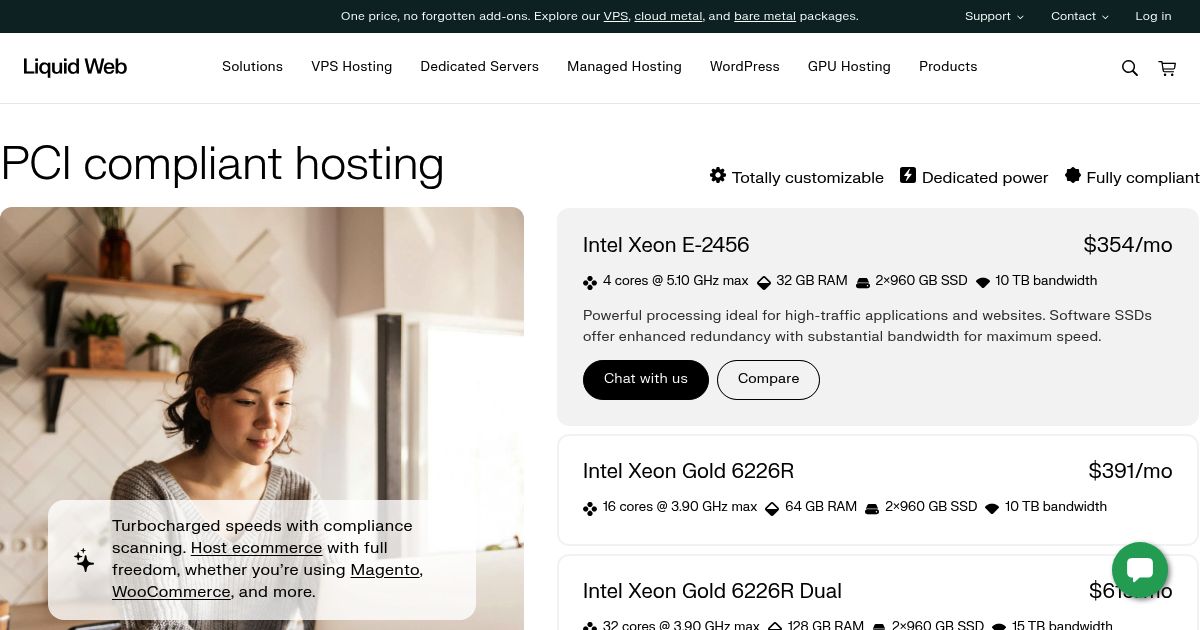
Liquid Web provides managed dedicated and cloud hosting that supports PCI-related workloads. Rather than positioning itself as a compliance provider, the company focuses on delivering managed infrastructure with optional quarterly vulnerability scans and remediation assistance. This managed approach appeals to businesses that want PCI-capable infrastructure without handling day-to-day server management or security hardening themselves.
Liquid Web is commonly used by ecommerce businesses and agencies running platforms like WooCommerce and Magento. Pricing starts higher than regular dedicated or cloud hosting, but reflects the added value of management, security support, and enterprise-grade reliability.
What We Like
- Fully managed dedicated and private cloud hosting options
- PCI vulnerability scanning available as an add-on
- Strong focus on ecommerce platforms such as WooCommerce and Magento
- Experienced support team familiar with PCI-related workloads
Disadvantages
- Expensive compared to unmanaged or DIY hosting options
3. Google Cloud Platform

Website: https://cloud.google.com/
Google Cloud Platform supports PCI DSS–certified infrastructure services under a shared responsibility model. The platform provides compliant building blocks, but customers remain responsible for application security, scans, and overall compliance.
The platform offers pay-as-you-go infrastructure services such as Compute Engine, Cloud SQL, and VPC networking. This flexibility allows development teams to design custom PCI workloads, but also requires in-house expertise to configure, monitor, and audit environments correctly.
Google Cloud is best suited for engineering-led teams building custom PCI-sensitive applications. While the platform delivers enterprise-grade infrastructure and global scale, its complexity and pricing model can be challenging for smaller teams without dedicated cloud or compliance expertise.
What We Like
- PCI-certified infrastructure services at the platform level
- High flexibility for custom PCI workload design
- Strong ecosystem of native AI, data, and security tools
- Global infrastructure backed by Google
Disadvantages
- Complex setup and steep learning curve
- Customers are fully responsible for scans and application-level compliance
4. InMotion Hosting

Website: https://www.inmotionhosting.com/
InMotion Hosting supports PCI-capable environments through its VPS, bare metal, and dedicated server offerings, but does not provide PCI compliance certification or auditing services. Instead, it focuses on delivering stable infrastructure that businesses can configure to meet PCI requirements on their own.
InMotion Hosting is commonly used by small and mid-sized businesses that rely on external payment processors to handle card data. This approach allows merchants to reduce PCI scope while using more affordable infrastructure compared to fully managed or compliance-first providers.
What We Like
- Lower entry cost compared to other PCI-capable infrastructure providers
- VPS and dedicated hosting suitable for custom PCI configurations
- Long business track record and reliable customer support
Disadvantages
- No PCI scanning or auditing support by default
5. Kinsta

Website: https://www.kinsta.com/
Kinsta enables PCI-friendly setups by isolating and securing WordPress and WooCommerce sites at the infrastructure level. While it does not offer PCI certification or auditing assistance, its managed environment helps reduce security risks commonly associated with WordPress hosting.
Kinsta is best suited for WooCommerce and content-driven sites that rely on hosted payment gateways such as Stripe. By ensuring card data never touches the server, businesses can operate within a much smaller PCI scope while benefiting from a highly optimized managed WordPress platform.
What We Like
- Managed WordPress hosting built on Google Cloud infrastructure
- Strong isolation, performance optimization, and security controls
- Expert WordPress-focused support
Disadvantages
- No PCI auditing or compliance assistance
Free Web Hosting Consultation
Need hosting advice that’s actually tailored to your needs? At HostScore.net, we’re here to help. Get a free chat with our team — we’ll match you with the best hosting options based on your goals, traffic, and growth plans.

Comparison Table: PhoenixNAP vs Alternatives
Hosting providers listed above approach PCI hosting in different ways. Some focus on delivering compliance-ready infrastructure, while others prioritize managed security or reducing PCI scope through external payment processing. The table below highlights how each option compares based on PCI positioning, compliance responsibility, and ideal use case.
| Provider | Hosting Type | PCI Support Approach | Compliance Responsibility | Best Fit For |
|---|---|---|---|---|
| PhoenixNAP | Bare Metal, Private Cloud | Compliance-ready infrastructure | Shared, infrastructure-heavy | Enterprises handling card data directly |
| Atlantic.Net | Cloud, Dedicated, Bare Metal | PCI-aligned hosting with audit support | Shared, guided | Regulated businesses needing turnkey PCI environments |
| Liquid Web | Managed Dedicated, Private Cloud | Managed hosting with PCI support | Shared, managed | Ecommerce and agencies wanting less infra overhead |
| Google Cloud Platform | Public Cloud | PCI-certified infrastructure services | Customer-owned | SaaS teams and engineering-led organizations |
| InMotion Hosting | VPS, Dedicated | PCI-capable infrastructure only | Customer-owned | SMBs outsourcing payments to gateways |
| Kinsta | Managed WordPress | PCI scope reduction via payment offloading | Minimal | WooCommerce and content-driven sites |
Which PhoenixNAP Alternative Is Right for You?
The right PhoenixNAP alternative depends on how your business handles payment data and how much compliance responsibility you want to manage.
Atlantic.Net and Google Cloud Platform are better suited for businesses that need PCI-oriented infrastructure. Atlantic.Net offers a more guided, compliance-first approach, while Google Cloud Platform provides flexible building blocks for teams that prefer full control.
Liquid Web is a strong fit for businesses that want managed hosting with PCI support. Its focus on managed servers and optional scanning appeals to ecommerce teams that prefer to outsource infrastructure management.
InMotion Hosting and Kinsta work best for businesses that reduce PCI scope by using hosted payment gateways. These options prioritize practicality and cost efficiency, making them suitable for small businesses, WooCommerce stores, and content-driven sites that do not handle card data directly.
Final Takeaway: Choosing the Right PhoenixNAP Alternative
PhoenixNAP alternatives for PCI-compliant hosting exist because not every business needs full bare-metal, audit-heavy infrastructure. Providers like Atlantic.Net and Google Cloud Platform suit organizations that still require compliance-oriented environments, while Liquid Web offers a managed path for PCI workloads. InMotion Hosting and Kinsta work best for businesses that reduce PCI scope by outsourcing payments.
The right choice depends on how your site handles payment data and how much infrastructure responsibility you want to manage. If you are unsure which hosting model fits your PCI requirements, comparing providers based on real use cases leads to better long-term decisions.

