

Atlantic.Net, LiquidWeb, Ultahost, KnownHost, and DigitalOcean (Gradient) are the strongest InMotion Hosting alternatives for bare metal servers. These providers stand out in HostScore’s evaluations for how they deliver single-tenant physical servers, define management responsibility, and support workloads that require more control than InMotion’s standard dedicated offerings.
This article examines how each alternative approaches bare metal infrastructure, where operational ownership sits, and which deployment scenarios each provider fits best. The comparison reflects HostScore’s focus on infrastructure behavior and long-term suitability rather than promotional pricing or surface-level specifications.
What Makes Bare Metal Different from Managed Dedicated Hosting?
Bare metal hosting differs from managed dedicated hosting in how server control, provisioning, and responsibility are handled. Bare metal servers run on single-tenant physical hardware without a virtualization layer, giving users direct access to the underlying machine. Managed dedicated hosting, while also single-tenant, applies a predefined management stack that limits how the server is configured and maintained.
The distinction matters because bare metal prioritizes hardware-level control and predictable performance, while managed dedicated hosting prioritizes operational convenience. Bare metal environments place more responsibility on the user or infrastructure team, whereas managed dedicated services handle a larger share of system updates, monitoring, and ongoing maintenance.
For a deeper explanation of bare metal provisioning models, management boundaries, and scaling trade-offs, refer to our dedicated guide on what bare metal servers are and how they work.
InMotion Hosting Alternatives for Bare Metal Servers
1. Atlantic.Net
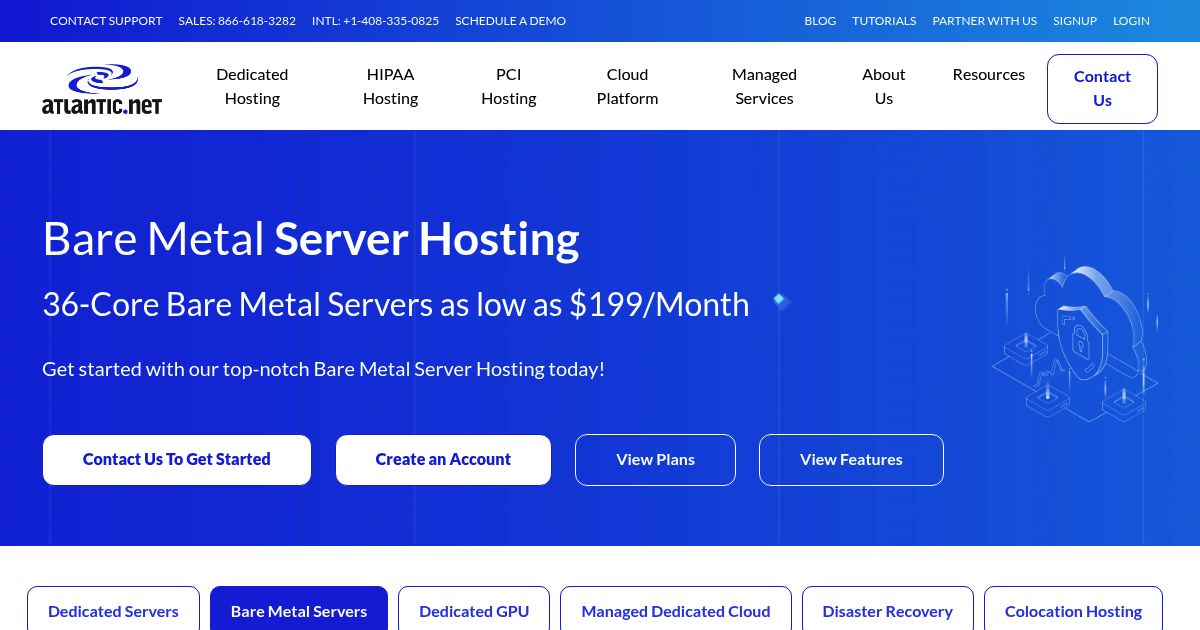
Website: https://www.atlantic.net/bare-metal-servers/
Atlantic.Net provides bare metal dedicated servers built for performance-sensitive and compliance-driven environments. Its bare metal lineup uses modern Xeon and EPYC CPUs paired with NVMe storage, making it suitable for workloads that require predictable throughput and consistent latency.
Why Atlantic.Net Works as a Bare Metal Alternative
Atlantic.Net focuses on delivering physical server control without forcing users into a rigid management model. This balance is one of its strongest differentiators. Key strengths include:
- Modern CPU options, including Xeon and EPYC processors
- NVMe-backed storage configurations for higher I/O consistency
- Enterprise-grade hardware suited for regulated or audited environments
- Optional management layers that keep infrastructure responsibility clearly defined
Operational Trade-offs to Consider
Atlantic.Net follows a more traditional provisioning approach compared to cloud-native bare metal platforms. Limitations to be aware of:
- Provisioning is not instant or API-driven
- Fewer global locations than hyperscale providers
How It Compares to InMotion Hosting
For users moving away from InMotion Hosting, Atlantic.Net offers deeper hardware options and stronger compliance alignment. It is better suited for teams that want deliberate control over physical infrastructure rather than a generalized managed dedicated setup.
2. LiquidWeb

Visit Online: https://www.liquidweb.com/
Liquid Web offers fully managed bare metal dedicated servers built for stability, uptime, and service reliability. Its bare metal platform is designed for organizations that prefer to offload server operations while retaining the benefits of single-tenant physical hardware.
Why Liquid Web Works as a Bare Metal Alternative
Liquid Web emphasizes operational consistency over flexibility. Based on our market research, its strength lies in how much infrastructure responsibility it removes from the customer. Key strengths include:
- High-quality enterprise hardware across its bare metal lineup
- Strong network reliability backed by uptime guarantees (our recent load tests confirm this)
- Fully managed services that cover monitoring, updates, and incident response
- A mature support organization with a long track record
Operational Trade-offs to Consider
Liquid Web’s managed-first approach comes with constraints that may not suit all bare metal users. For readers considering Liquid Web, take note on the following drawbacks:
- Significantly higher pricing than most bare metal alternatives
- Fewer server location options compared to global providers
How It Compares to InMotion Hosting
In comparison to InMotion Hosting, Liquid Web offers deeper management and stronger service guarantees, but at a much higher cost. It is better suited for teams that value uptime and operational coverage over pricing flexibility or hardware customization.
3. Ultahost

Visit Online: https://www.ultahost.com/
Ultahost provides budget-friendly bare metal dedicated servers aimed at cost-sensitive deployments. Its bare metal plans lower the entry barrier to physical server ownership, making them accessible to smaller teams and international workloads.
Why Ultahost Works as a Bare Metal Alternative
Ultahost focuses on affordability and regional availability (wide choice in server locations!) rather than premium hardware. Their key strengths include:
- Very low entry pricing for bare metal servers
- Availability across multiple regions for latency-sensitive use cases
- Suitable for workloads that require physical servers without advanced customization
Operational Trade-offs to Consider
Lower pricing comes with practical limitations in hardware and performance ceilings. Two main limitations with Ultahost:
- Older CPU generations on entry-level plans
- Lower disk I/O and network throughput compared to premium providers
How It Compares to InMotion Hosting
For users considering InMotion Hosting primarily on cost, Ultahost offers a cheaper path to bare metal ownership. However, it trades modern hardware and higher performance ceilings for affordability, making it more suitable for non-critical or budget-constrained workloads.
4. KnownHost

Visit Online: https://www.knownhost.com/
KnownHost offers no-frills bare metal dedicated servers built around stability and long-term reliability. Its bare metal lineup favors conservative hardware configurations that prioritize predictable performance over cutting-edge specifications.
Why KnownHost Works as a Bare Metal Alternative
KnownHost focuses on operational consistency and proven infrastructure rather than rapid innovation. Key strengths include:
- Stable and predictable bare metal performance
- Proven hardware configurations designed for long-term use
- A support model oriented toward reliability rather than aggressive scaling
Operational Trade-offs to Consider
Limitations in KnownHost to be aware of:
- Limited access to newer CPU generations
- Fewer high-density NVMe or GPU configuration options
- Smaller global footprint compared to hyperscale providers
How It Compares to InMotion Hosting
KnownHost offers a more conservative bare metal option with fewer customization choices compared to InMotion Hosting. It is better suited for workloads that value stability and predictability over rapid growth or experimental infrastructure changes.
5. Digital Ocean (Gradient Bare Metal)

Visit Online: https://www.digitalocean.com/
DigitalOcean Gradient provides specialized bare metal servers designed for GPU-accelerated and AI workloads. Unlike traditional bare metal providers, Gradient focuses on high-performance compute rather than general-purpose hosting.
Why DigitalOcean Gradient Works as a Bare Metal Alternative
Gradient is built for teams that need dedicated GPU hardware with full physical isolation.
Key strengths include:
- Dedicated GPU-based bare metal servers
- Full isolation for AI and compute-intensive workloads
- Infrastructure designed for high-performance training and inference tasks
Operational Trade-offs to Consider
Gradient is not designed for general-purpose bare metal hosting. For readers switching over, be aware of the following limitations:
- Not suitable for standard web or application hosting
- Contract-based, sales-led provisioning model
- Limited or minimal customer support compared to managed hosting providers
How It Compares to InMotion Hosting
DigitalOcean Gradient represents a different bare metal path altogether. For users moving away from InMotion Hosting due to AI or accelerator-driven requirements, Gradient offers capabilities that traditional bare metal providers do not. However, it is not a direct replacement for general-purpose dedicated servers.
Setting up hosting can be confusing. That’s why we created HostScore Setup Help, a done-for-you service for getting your hosting configured the right way.
We help with SSL installation, DNS & nameserver setup, WordPress install or migration, and security tuning. One-time fee. Backed by a 100% refund guarantee.
Explore Our ServicesHow These Providers Compare to InMotion’s Bare Metal Offering?

InMotion Hosting offers a managed bare metal experience designed for general-purpose workloads, with an emphasis on service coverage and ease of operation. The alternatives below differ primarily in management depth, hardware focus, pricing posture, and deployment intent, giving users more targeted options depending on how much control and responsibility they want to retain.
The table below highlights how each provider’s bare metal approach compares to InMotion Hosting at a high level.
Bare Metal Comparison: InMotion Hosting vs Alternatives
| Provider | Pricing Reality | Hardware Details | Server Availability | Best At | Key Limitation |
|---|---|---|---|---|---|
| InMotion Hosting | Mid-range. Entry pricing promoted low; higher tiers via sales. | Standard enterprise CPUs, mixed SSD/NVMe | US & EU only | Managed simplicity | Limited flexibility and specialization |
| Atlantic.Net | Higher than InMotion, but controlled. From ~$138/mo, scaling to $600+/mo for EPYC/NVMe. | Modern Intel Xeon & AMD EPYC, NVMe standard | Fewer regions, compliance-focused | Regulated & audited workloads | Slower, traditional provisioning |
| LiquidWeb | One of the most expensive options, typically $500–650+/mo. | Enterprise-grade hardware, slower refresh cycles | Limited global footprint | Stability & SLA-backed uptime | Cost and limited hardware agility |
| Ultahost | Significantly cheaper than InMotion; entry plan from ~$74.80/mo. | Older CPU generations on entry plans | Wide global coverage | Budget bare metal access | Lower I/O and performance ceilings |
| KnownHost | Mid-range; from ~$109/mo, scaling with specs. | Conservative, proven hardware configs | Limited regions | Long-term reliability | Minimal customization |
| DigitalOcean (Gradient) | Contract-based, high-cost. | Dedicated GPU bare metal only | Very limited | AI & HPC workloads | Not general-purpose hosting |
When Bare Metal Is the Right Choice; and When It Isn’t?
Bare metal hosting is the right choice when workloads require dedicated physical resources, predictable performance, or strict isolation. Applications with steady CPU and disk usage, compliance-sensitive environments, and systems that cannot tolerate noisy neighbors often benefit most from single-tenant hardware.
Bare metal is not always the best option for fast-changing or traffic-spiky workloads. Projects that need rapid scaling, frequent resizing, or short-term experimentation are often better served by cloud or virtualized infrastructure, where flexibility outweighs hardware ownership.
Choosing bare metal should be a deliberate infrastructure decision, not a default upgrade. Understanding when physical servers add real value helps avoid unnecessary cost and operational complexity.
Conclusion: Choosing the Right InMotion Hosting Alternative for Bare Metal Servers
Choosing the right InMotion Hosting alternative for bare metal servers comes down to how much control, specialization, and long-term predictability your infrastructure requires. While InMotion provides a solid managed bare metal baseline, providers like Atlantic.Net and Liquid Web cater better to compliance-heavy or stability-first environments, while Ultahost and KnownHost appeal to cost-conscious or reliability-focused deployments. DigitalOcean Gradient stands apart as a specialized option for GPU and AI-driven workloads rather than general-purpose hosting.
Bare metal is most effective when chosen intentionally. Matching the provider’s hardware focus, pricing posture, and deployment intent to your actual workload is what determines long-term fit.

