

Running multiple websites, blogs, or client projects on a budget? Unlimited Web Hosting Plans are designed for users who need flexibility — offering unmetered storage, bandwidth, and addon domains at a fraction of the cost of VPS or cloud servers.
In this guide, we’ve compared the top unlimited hosting providers based on real-world performance, fair usage policies, support quality, and pricing — so you can find a reliable host that won’t hit you with surprise limits or upsells as your site traffic grows.
Top Unlimited Hosting Providers Compared
| Provider | Key Unlimited Features | Fair Usage Limitations |
|---|---|---|
| Hostinger | Unmetered bandwidth (higher plans) | Limits on storage space, number of websites, inodes, PHP workers |
| HostPapa | Unmetered bandwidth, unlimited websites, unlimited email accounts | Limits on inbox storage, website backup, and server resources (CPU cores, MySQL usages, and inodes) |
| HostArmada | Unmetered bandwidth, unlimited websites | Limits on storage space and other server resources |
| UltaHost | Unmetered bandwidth, unlimited websites | Limits on storage space and server resources |
| GreenGeeks | Unmetered bandwidth, unlimited websites, unlimited email accounts | Limits on storage space and other server resources |
| InMotion Hosting | Unmetered bandwidth, unlimited websites, unlimited storage, unlimited email accounts | Limits on server resources |
Note: Our HostScore ratings offer a broad view of web host performance, but your specific needs may vary. This guide provides tailored recommendations to help you find the best unlimited hosting solutions.
1. Hostinger

Hostinger is known for its affordable unlimited hosting, offering unmetered bandwidth across its shared hosting plans. However, to maintain service stability, usage limits exist in the form of inodes, PHP workers, and website hosting restrictions. These limitations ensure that servers remain optimized for all users.
Despite these constraints, Hostinger delivers strong value with its high-speed performance, free domain, and easy-to-use control panel. For those looking to host multiple sites without breaking the bank, Hostinger remains a solid choice.
Hostinger Unlimited Hosting Features

- Unlimited SSD / NVMe-SSD storage
- Unmetered bandwidth
Hostinger Pros
- Affordable entry plan at $2.99/month for 3 websites, plus 15% off with HOSTSCORE15.
- Global network of data centers in Europe, Asia, North America, and South America
- Excellent AI ecosystem with AI Builder (new!), Hostinger Agent with memory, OpenClaw, Hermes, n8n, and Paperclip
- User-friendly hPanel with API and MCP access for AI-assisted hosting management
- Developer API and MCP integration - Hostinger Connector lets Claude, Cursor, Codex, and other MCP-compatible tools manage websites
- Multiple payment methods accepted, including crypto and digital wallets
Hostinger Cons
- The lowest price requires 48 months upfront and renews at $10.99/month
- Advanced Agent features and managed AI applications may require separate paid plans
- Hostinger AI Builder sites have limited portability compared with WordPress websites
- Hostinger does not support Windows hosting.
2. HostPapa

HostPapa offers unlimited website hosting on its Premium and Elite shared hosting plans. While lower-tier plans limit you to 1 or 5 websites, upgrading to these higher tiers unlocks unmetered NVMe storage, unlimited websites, and enhanced performance resources.
Unlike some budget hosts, HostPapa clearly defines its resource allocation. Each plan comes with transparent CPU, RAM, and I/O limits to maintain stability for all users. Bandwidth remains unmetered under a fair usage policy, and storage performance benefits from NVMe technology, which accelerates file reads and writes compared to standard SSDs. The Premium plan also includes a Premium SSL certificate, while the Elite plan upgrades that to a Wildcard SSL for multi-site protection.
Although not the cheapest provider in this category, HostPapa’s value lies in its transparency, advanced security coverage through Imunify360, and dependable customer support network spanning 16 countries. These strengths make it a trustworthy option for users who prioritize reliable “unlimited” hosting over aggressive discount pricing.
HostPapa Unlimited Hosting Features

- Host unlimited websites (Premium and Elite plans)
- Unmetered NVMe storage and bandwidth (fair use policy applies)
- Transparent resource allocation for predictable performance
HostPapa Pros
- Affordable entry pricing — NVMe storage, CloudLinux OS, and free SSL included even in basic plans.
- Global operations with local support
- Beginner-friendly setup with cPanel control panel and free migration
- Excellent customer support
- Extra business services, offers Microsoft 365, Google Workspace email, web design, malware removal, and more
- Strong public reputation with consistently positive user feedback
HostPapa Cons
- Limited websites on lower tiers — only 1 site on Essentials and 5 on Growth plans.
- Entry plan lacks staging and advanced security
- No data centers beyond North America and Europe
- High renewal rates for shared plans
3. HostArmada

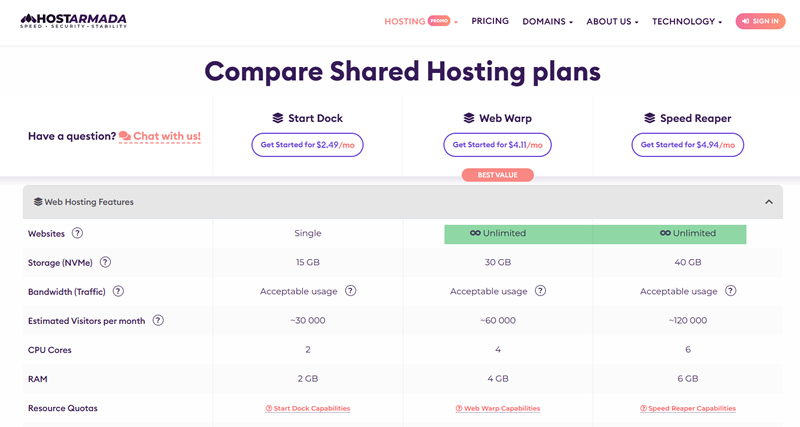
HostArmada provides unlimited website hosting, making it a great option for users managing multiple sites. While bandwidth is unmetered, the company clearly outlines acceptable usage policies, ensuring that customers stay within fair limits. Excessive resource consumption may trigger account review or plan upgrades, but for most users, this won’t be an issue.
With its free daily backups, cPanel access, and advanced security features, HostArmada delivers a reliable unlimited hosting experience at a reasonable price.
HostArmada Unlimited Hosting Features
- Host unlimited websites
- Unmetered bandwidth (fair use policy applies)
HostArmada Pros
- Competitive pricing
- Daily remote backups with up to 21 days of restore points
- NGINX server and NVMe storage for all shared hosting plans
- 45-day money-back guarantee
- Free malware scans and Web Application Firewall (WAF) on all shared hosting plans
- Supports hosting of legal adult content websites
- Wide range of server locations
HostArmada Cons
- Price increases upon renewal
- Entry-level plan supports only one website
- Advanced speed features like dynamic caching are limited to the highest-tier shared plan
- No Windows Server hosting option
4. UltaHost

UltaHost markets its hosting plans with unlimited bandwidth, but a fair usage policy ensures that server resources are distributed fairly. Unlike some providers, UltaHost does not publicly disclose specific limits, meaning accounts with excessive resource consumption may be reviewed on a case-by-case basis.
For most users, this won’t be a problem – UltaHost’s solid performance, free migration, and built-in security make it a reliable unlimited hosting option.
UltaHost Unlimited Hosting Features

- Unlimited websites (on higher plans)
- Unlimited bandwidth (fair use applies)
Ultahost Pros
- Outstanding hosting uptime and speed performance
- Highly competitive pricing
- Wide choice of server locations in four continents
- NVMe storage, DDoS protection, and unmetered traffic included
- Free malware scan & web applications firewall (WAF) in all shared plans
- Dedicated plans offer wide choice of Intel Xeon, AMD Ryzen, and AMD EPYC processors
Ultahost Cons
- Lowest prices require a long initial billing term
- Renewal prices are higher than discounted signup rates
- Some dedicated server locations carry additional monthly charges
5. GreenGeeks

GreenGeeks isn’t just about unlimited hosting—it’s a green energy-powered provider that offsets 300% of its energy consumption. Their plans come with unlimited storage, bandwidth, and email accounts, but GreenGeeks enforces usage limitations on CPU, RAM, and disk I/O to maintain server performance.
For eco-conscious website owners, GreenGeeks offers reliable performance, free CDN integration, and built-in security tools—all while keeping the planet in mind.
GreenGeeks Unlimited Features

- Unlimited websites (higher plans)
- Unlimited email accounts email (higher plans)
- Unmetered data transfer bandwidth
GreenGeeks Pros
- 300% green energy offset with RECs
- Affordable entry pricing for shared and WordPress hosting plans
- Free daily backup for all shared hosting plans
- Partnership with One Tree Planted plants a tree for every new hosting account
- Free website migration assistance
- Enhanced scalability options with VPS and dedicated plans
GreenGeeks Cons
- Higher renewal rates across shared and WordPress plans
- Slightly lackluster customer service, with complaints of limited support for customers transferring domains out of the platform
- No Windows Server hosting option
6. InMotion Hosting

InMotion Hosting provides unlimited storage and bandwidth across its shared hosting plans. However, if a website starts affecting server performance, InMotion requires customers to upgrade to a higher-tier plan.
With fast SSD storage, excellent support, and high uptime reliability, InMotion Hosting remains a strong contender for unlimited hosting – especially for growing businesses.
InMotion Hosting Unlimited Features
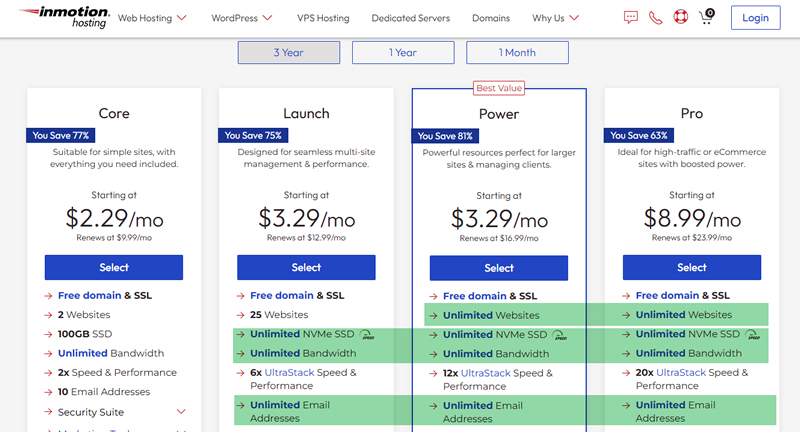
- Unlimited storage (higher plans)
- Unmetered data transfer bandwidth
- Unlimited websites (higher plans)
- Unlimited email accounts (higher plans)
InMotion Hosting Pros
- Affordable entry pricing
- Developer stack on all shared hosting plans (Python/Node/Ruby, Git, SSH)
- Built-in hack, DDoS, and malware protection
- Long 90-day money back guarantee refund window (best in market)
- Free SSL, email, and site migration
InMotion Hosting Cons
- Lower shared hosting plans lack advanced speed features
- Higher renewal rates across shared, VPS, and reseller plans
- No Asia-based data center
- No Windows Server hosting option
Setting up hosting can be confusing. That’s why we created HostScore Setup Help, a done-for-you service for getting your hosting configured the right way.
We help with SSL installation, DNS & nameserver setup, WordPress install or migration, and security tuning. One-time fee. Backed by a 100% refund guarantee.
Explore Our ServicesWhat is Unlimited Web Hosting?
Unlimited Hosting refers to web hosting offers that come with unlimited disk storage, data transfer and in some cases, unlimited addon domains and websites. While technically it’s impossible for any company to host “unlimited” websites (more about this later), no-limit hosting plans are very popular – mainly because it reduces the cost of hosting multiple sites significantly.
How Is Unlimited Hosting Possible?
Take HostPapa as an example. The company advertises unlimited websites and unmetered NVMe storage on its Premium and Elite shared hosting plans — both priced under $10/month. Yet, the same provider’s Dedicated Hosting plans can cost hundreds per month and still come with clearly defined limits on CPU cores, RAM, and storage capacity.
At first glance, that sounds contradictory. Why would a “cheap” shared plan be unlimited while a dedicated server isn’t?
The answer lies in how web hosts define “unlimited.” On shared hosting, the term refers to the absence of fixed caps on bandwidth or storage per account, but all users still share the same physical server. HostPapa, for instance, enforces fair usage and resource allocation rules to ensure no single customer consumes excessive CPU, RAM, or I/O at others’ expense. Once those limits are reached, performance throttling or plan upgrades may be required.

In contrast, dedicated hosting allocates every hardware resource exclusively to one client, which is why the specifications are explicitly stated and the price is higher.
So, when you see “unlimited hosting,” remember: it’s unlimited within reasonable use, not infinite resources. HostPapa makes this clear through its transparent plan descriptions and fair usage policies — a level of honesty that not every host provides.
Unlimited Hosting is Always Limited

The truth is, unlimited hosting is never truly unlimited. We live in a finite world.
It’s impossible to:
- Have unlimited physical servers.
- Lay unlimited network cables.
- Hire unlimited manpower to maintain servers.
“Unlimited” is a marketing term that comes with restrictions—hidden deep within the provider’s Terms of Service (ToS).
Why Do Hosting Companies Offer Unlimited Hosting?
Web hosting is a highly competitive business. Providers use every tactic possible to attract customers – free migrations, free Google Ads credits, and, of course, unlimited hosting.
The “unlimited” marketing trend started in the mid-2000s. If memory serves me right, Bluehost was among the first companies to introduce it.
Since most people associate “more” with “better”, unlimited hosting became an effective sales strategy.
How Does Unlimited Hosting Work?
Now that we know why hosting companies offer unlimited plans, let’s explore how they make it possible.
Overselling: The Real Mechanism Behind Unlimited Hosting
Overselling happens when a hosting provider sells more server resources than it actually has.
Large hosting companies have massive infrastructure – from bandwidth pipes to server clusters. The average website barely uses a fraction of these resources. Knowing this, hosting companies reallocate unused server capacity to other users – this is overselling in action.
Unlimited Hosting Works… Until You Use Too Much
Think of an all-you-can-eat buffet. The sign says “unlimited food”, but when you arrive, there’s a catch: only diners under 154 lbs (70 kg) can enter.
That’s how unlimited hosting works.
You’re welcome to host unlimited websites and use unlimited storage—until you exceed hidden limits.
These limits are buried in the provider’s ToS – not in flashy marketing pages.
What Are the Restrictions on Unlimited Hosting?

Every hosting provider has “fair use” policies that restrict server usage. For examples:
- Hostinger: Offers unlimited (or termed as “unmetered”) data transfer but limit server capacity in inodes, PHP workers, and number of websites you can host per account.
- A2 Hosting: Imposes a limit of 600,000 inodes on shared hosting accounts and 35 concurrent HTTP connections to the server. Exceeding these limits may lead to account suspension or additional charges.
- UltaHost: While offering unlimited bandwidth, UltaHost enforces a fair usage policy to prevent activities that could jeopardize service stability. Specific limits are not publicly detailed, but excessive resource usage may lead to account review and potential restrictions.
- Verpex: Offers unlimited bandwidth but enforces a 100 websites limit and restricts memory usage to 2 GB.
- Web Hosting UK: Operates under a fair use policy for shared resources. While specific limits may not be defined, excessive usage affecting server performance can lead to remedial actions, including upgrading to a more suitable plan or service suspension (see screenshot above).
- Fusion Arc Hosting: Enforces inode limits on shared hosting plans, ranging from 100,000 to 501,000, depending on the plan. Exceeding these limits may lead to account review and potential restrictions.
As soon as your website exceeds these hidden limits, hosting companies suspend your account or charge extra fees – and believe me, those charges can be hefty.
Is Unlimited Hosting Unethical?
Some argue that overselling and unlimited hosting plans are misleading. However, that doesn’t make them evil.
In fact, overselling keeps hosting prices low. For example, when HostGator introduced unlimited hosting (back in the 2000’s), they spent over a year hiring staff and upgrading infrastructure before making the switch.
Brent Oxley, HostGator’s founder, explained their move to unlimited hosting:
I wanted to call the plans unlimited last time around. However, due to staffing constraints, we wouldn’t have been able to keep up with the expected growth. A year later, we are finally OVERSTAFFED and ready to change the plan. Up until now, I’ve been slowing sales down on purpose in order for our support to catch up. If history repeats itself, renaming the plan from essentially unlimited to actually “unlimited” will increase our sales by at least 30%.”
In the last year, we have been spending more money on recruiting employees than we have on advertising! It has taken us years of hiring and training to get us to the point where we are now. We’ve gone from begging employees to work overtime to asking who wants to go home. HostGator will always have the occasional scheduling gap, but for now, we’re sending over a dozen employees home a day.
– Brent Oxley, Hostgator Founder & ex-CEO
In short, unlimited hosting is a business decision – one that enables affordable hosting without sacrificing quality.
Can You Trust Unlimited Hosting Providers?
Trusting an unlimited hosting provider depends on how well you understand their terms and limitations. Many reputable companies offer stable, high-quality hosting under an unlimited plan, but the key lies in knowing what “unlimited” actually means.
As we mentioned above – Unlimited hosting providers like A2 Hosting, GreenGeeks, and UltaHost market their plans as unlimited, but behind the scenes, server usage caps still exist – often hidden in the Terms of Service (ToS).
The real concern isn’t whether these providers are scamming customers, but whether they manage resources fairly. A good unlimited host ensures that most websites run smoothly without performance issues. However, if your website outgrows shared hosting resources, your account may be throttled, suspended, or forced to upgrade. This isn’t unethical – it’s simply the business model of shared hosting.
To find a trustworthy unlimited hosting provider, look beyond marketing claims. Evaluate uptime reliability, speed, support quality, and user reviews. A well-managed unlimited plan can offer great value, but only if you stay within the provider’s acceptable usage guidelines.
How to Overcome Unlimited Hosting Limitations?
Even though unlimited hosting plans have resource restrictions, there are ways to optimize your website and minimize the risk of exceeding them. The key is to reduce server load while maintaining fast performance.
- Use a Content Delivery Network (CDN): Services like Cloudflare reduce server load.
- Optimize your database: Regular maintenance speeds up queries.
- Leverage third-party tools: Offload processing using Google Forms or Facebook Comments.
- Enable aggressive caching: Reduce memory and CPU usage.
By proactively managing your resource usage, you can stay within the limits of your hosting plan and avoid unnecessary account restrictions or unexpected upgrade costs.
Recap: Is Unlimited Hosting a Scam?
No, unlimited hosting isn’t a scam. But it’s also not truly unlimited. It’s a marketing term designed to attract customers, but behind the scenes, all hosting providers impose usage limits to prevent excessive strain on their servers.
The way unlimited hosting works is through overselling – providers assume that most websites won’t use excessive resources, allowing them to offer seemingly unlimited features at low prices. However, if a website exceeds a provider’s fair use policy, it may face throttling, suspensions, or forced upgrades.
Instead of focusing solely on “unlimited” storage and bandwidth, consider real performance factors like uptime reliability, server speed, and customer support. To get the most out of an unlimited hosting plan, optimize your website with CDNs, caching, and database maintenance. By keeping your resource consumption low, you can maximize your hosting performance without running into hidden limitations.
At the end of the day, unlimited hosting is a cost-effective option for small to medium websites – as long as you understand its boundaries and choose a reliable provider.

