Based on our market research, the best GPU hosting providers are Atlantic.Net, Liquid Web, and DigitalOcean.
Atlantic.Net provides compliant infrastructure and recently expanded its GPU hosting portfolio with configurations optimized for healthcare, research, and machine learning workloads.
LiquidWeb deploys high-performance bare metal servers equipped with NVIDIA H100 and L40S GPUs, backed by managed support that caters to enterprise-grade AI and data analytics operations.
DigitalOcean offers affordable, on-demand access to modern GPUs such as the H100 and RTX 6000 Ada, enabling startups to scale AI applications quickly and control infrastructure costs.
To choose the best GPU hosting, evaluate how each provider balances GPU model performance, deployment type, and operational flexibility. Consider whether you need cloud-based instances or bare metal servers, how easily the environment scales, and how pricing adapts to usage. Data center proximity, compliance standards, and managed support quality also determine which GPU host delivers the right balance of power, control, and reliability for your workloads.
1. Atlantic.Net
Website: https://www.atlantic.net/gpu-server-hosting/
Atlantic.Net is a U.S.-based hosting provider known for its secure, compliant cloud infrastructure. The company has been in operation since 1994 and offers a range of cloud and dedicated hosting solutions. Atlantic.Net focuses heavily on serving healthcare, financial services, and other compliance-sensitive industries.
Best for Healthcare & Compliance-Ready GPU Hosting
Atlantic.Net’s GPU hosting is available through both cloud-based and dedicated server configurations, offering flexibility for businesses with varying performance and compliance needs. Cloud GPU instances are suitable for burstable workloads, such as AI inference or batch data processing, and can be spun up on demand.
For heavier, sustained compute needs like medical imaging or real-time AI pipelines, dedicated GPU servers equipped with NVIDIA H100 NVL or L40S can be fully customized to meet HIPAA, HITECH, or PCI compliance. Both models come with optional managed support, firewalls, private networking, and SSD storage.
What sets Atlantic.Net apart is its dual-path infrastructure — you can start with a low-cost cloud GPU and scale up to dedicated hardware as their workload matures. With multiple U.S. data centers and a strong emphasis on compliance, the platform is ideal for enterprises in healthcare, legal, and fintech industries looking to maintain control over GPU-driven operations.
Atlantic.Net GPU Hosting Pros & Cons
| Pros | Cons |
|---|---|
| HIPAA and PCI-compliant infrastructure | Limited data center locations outside the U.S. |
| Customizable dedicated GPU server configurations | |
| Choice of GPU hosting in cloud or dedicated environment | |
| Strong managed services and compliance support |
2. LiquidWeb

Website: https://www.liquidweb.com/
LiquidWeb is an enterprise-focused hosting provider offering high-performance VPS, dedicated, and cloud infrastructure. The company is known for its white-glove managed hosting services and strong service level agreements. Its clientele includes businesses running mission-critical applications that require consistent uptime and deep technical support.
Best for High-Performance Dedicated GPU Servers
LiquidWeb’s GPU hosting now features NVIDIA’s latest enterprise-grade GPUs including the L4, L40S, and H100 models. These GPUs are deployed on dedicated bare-metal servers optimized for intensive AI and deep learning workloads. The H100 in particular offers massive parallel processing capabilities — ideal for training large language models, running real-time analytics, and rendering high-resolution graphics. Each server setup is fully customizable and includes support for NVMe SSDs, private networking, and DDoS protection.
What differentiates LiquidWeb is its fully managed infrastructure and consultative deployment process. Clients work directly with hosting engineers to plan out their server architecture, GPU requirements, and workload optimization strategies. The company handles everything from deployment to ongoing system monitoring, freeing up businesses to focus entirely on model development or software delivery.
LiquidWeb GPU Hosting Pros & Cons
| Pros | Cons |
|---|---|
| High-performance GPU bare metal servers | Pricing is premium and quote-based |
| Hands-on managed hosting and support | Not suitable for casual or short-term usage |
| Enterprise-grade SLAs and uptime guarantee |
3. DigitalOcean

Website: https://digitalocean.com/
DigitalOcean is a developer-centric cloud provider known for its simplicity, transparent pricing, and ease of deployment. The company serves startups, SaaS developers, and SMBs that want to move quickly without the complexity of hyperscale platforms.
Best for Scalable GPU Virtual Machines
DigitalOcean’s GPU offering has evolved significantly and now includes NVIDIA H100, RTX 4000 Ada, RTX 6000 Ada, and L40S GPUs under its GPU Droplets product line. These instances are designed for AI inference, training smaller ML models, video rendering, and even 3D simulation. Each Droplet can be provisioned with 1 to 4 GPUs and includes optional vCPUs, RAM, and SSD storage. Pre-configured OS images for frameworks like PyTorch and TensorFlow are also available.
The platform’s key advantage is developer accessibility. Deploying a GPU Droplet takes minutes via a user-friendly dashboard or REST API. Billing is hourly or monthly, and all costs—compute, bandwidth, and storage—are clearly outlined. This makes Digital Ocean an ideal choice for teams building and testing AI applications on a budget, or for devs who need short-term GPU access without the friction of enterprise onboarding.
DigitalOcean GPU Hosting Pros & Cons
| Pros | Cons |
|---|---|
| Fast deployment | No support for complex enterprise configurations |
| Transparent, fixed pricing for GPU instances | |
| Global availability in multiple data centers |
4. Vultr

Website: https://vultr.com/
Vultr is an independent cloud infrastructure provider offering cloud compute, bare metal, and GPU hosting across 30+ global locations. It’s built for developers, game studios, and AI startups seeking high-performance servers at predictable pricing.
Best for Flexible Cloud GPU Solutions
Vultr offers an extensive GPU portfolio, including NVIDIA HGX B200, H100, H200, A100, L40S, A40, and A16 cards. These are available as Cloud GPU instances (virtualized) and dedicated bare metal servers. Use cases range from training transformer models and building AI SaaS tools to running 3D visualization platforms. Users can deploy GPU-powered instances in seconds, configure custom OS environments, and scale via API.
Vultr shines with its server range and pricing flexibility. Whether you need to rent an H100 for a week-long training job or launch a streaming app using A40, the billing is hourly and granular. It also allows ISO uploads, private networking, and advanced provisioning — all from a clean dashboard or automation-friendly API. This makes Vultr a favorite among users who want access to top-tier GPUs without cloud complexity.
Vultr GPU Hosting Pros & Cons
| Pros | Cons |
|---|---|
| Broad GPU selection including HGX B200 and H100 | Limited managed services — DIY-focused |
| Fast provisioning and cost-effective billing | Support response times can vary depending on plan |
| Supports both cloud VMs and bare metal setups |
5. OVHcloud

Website: https://ovhcloud.com/
OVHcloud is a major European cloud provider with a strong focus on data sovereignty, scalability, and value pricing. The company operates dozens of data centers across the EU, North America, and Asia-Pacific, and adheres closely to GDPR and other regional data regulations.
Best for Customizable GPU Hosting Solutions
OVHcloud offers a range of dedicated GPU servers powered by NVIDIA H100, L40S, and L4 GPUs. These are tailored for deep learning, big data analysis, 3D modeling, and virtualization. Customers can choose from pre-configured GPU setups or customize hardware configurations including RAM, disk types, and network throughput. Each server includes anti-DDoS protection and can integrate with OVHcloud’s object storage or Kubernetes ecosystem.
The platform’s biggest strengths are its EU compliance and pricing transparency. Compared to hyperscalers, OVHcloud offers more affordable high-performance GPU instances with no hidden bandwidth charges. This makes it particularly appealing to EU-based researchers, SaaS companies, and digital agencies building GPU-intensive platforms.
OVHCloud GPU Hosting Pros & Cons
| Pros | Cons |
|---|---|
| Affordable H100, L40S, and L4 server configurations | UI/UX and onboarding can be complex for new users |
| Strong compliance (GDPR) and privacy focus | Minimal managed support outside add-ons or partners |
| High configurability and dedicated network options |
Comparison Among the Best GPU Hosting Providers
Each of the five GPU hosting providers excels in different areas, from HIPAA-compliant infrastructure and enterprise-grade bare metal servers to affordable cloud-based GPU instances for developers.
Atlantic.Net and LiquidWeb target businesses with strict security or performance requirements, offering fully customizable hardware and white-glove support. DigitalOcean and Vultr, on the other hand, cater to startups and dev teams that need fast, affordable access to GPU power without complicated contracts. OVHcloud stands out for its strong EU presence and competitive pricing on high-performance GPUs.
Here’s how these providers stack up across key criteria:
| Feature | Atlantic.Net | LiquidWeb | DigitalOcean | Vultr | OVHcloud |
|---|---|---|---|---|---|
| Best For | Compliance-heavy industries (e.g. healthcare, finance) | Enterprise AI and compute-heavy workloads | Dev teams needing easy GPU access | Budget GPU hosting with global reach | EU-based businesses with large-scale needs |
| GPU Types | NVIDIA H100 NVL, L40S | NVIDIA L4, L40S, H100 | NVIDIA H100, RTX 4000 Ada, RTX 6000 Ada, L40S | NVIDIA HGX B200, H100, H200, A100, L40S, A40, A16 | NVIDIA H100, L4, L40S |
| Hosting Type | Cloud & Dedicated GPU Servers | Bare Metal Servers | Cloud VMs (Droplets) | Cloud VMs & Bare Metal | Dedicated GPU Servers |
| Customization | Full hardware customization | Fully customizable with engineer support | Pre-configured only | Moderate (ISO, VM settings, APIs) | Pre-configured or custom builds |
| Ease of Use | Medium (manual setup) | Medium (with managed service support) | High (UI focused for developers) | High (self-serve panel, API) | Medium (some onboarding complexity) |
| Compliance Support | HIPAA, HITECH, PCI | PCI, SOC2 (optional) | None officially | Not compliance-focused | GDPR-friendly, EU-centric |
| Pricing Model | Monthly / Contract-based | Monthly / Custom quote | Fixed monthly/hourly | Hourly and monthly billing | Competitive monthly billing |
| Global Data Centers | US-focused | US and EU | 14+ locations worldwide | 32+ locations worldwide | Strong EU + Canada presence |
| Managed Services | Optional (fully managed available) | Included (white-glove) | None | Limited (mostly self-managed) | Minimal unless paired with add-ons |
Which GPU Hosting is Best for High-Traffic Websites?
Atlantic.Net is best suited for high-traffic websites that also need GPU acceleration, especially in regulated industries like healthcare or finance. Its dedicated GPU servers support HIPAA and PCI compliance, and the company’s infrastructure includes advanced firewall, DDoS protection, and performance optimization features. This makes the web host a good choice for businesses running high-load platforms that involve video processing, real-time analytics, or personalization engines.
Which GPU Hosting is Best for AI/ML Workloads?

For general-purpose AI/ML workloads, LiquidWeb offers the most powerful hosting environment. Its bare-metal servers come with top-tier NVIDIA GPUs like the H100, L40S, and L4, making them suitable for both training and inference in machine learning pipelines. Whether you’re building large language models, fine-tuning vision transformers, or deploying real-time AI APIs, LiquidWeb gives you direct access to the full compute capacity of your GPUs.
Each deployment is fully customizable — allowing users to configure memory, storage type (including NVMe SSDs), network throughput, and even redundant backups. The environment is especially suitable for businesses building their own infrastructure stack or integrating with orchestration frameworks like Kubernetes or Slurm.
What also sets LiquidWeb apart is its engineer-assisted provisioning and white-glove support. While other platforms leave you to self-manage configurations, LiquidWeb’s team collaborates on architecture planning, GPU resource optimization, and performance tuning—an asset for any team scaling machine learning operations.
Which GPU Hosting is Best for AI Projects in Regulated Industries?
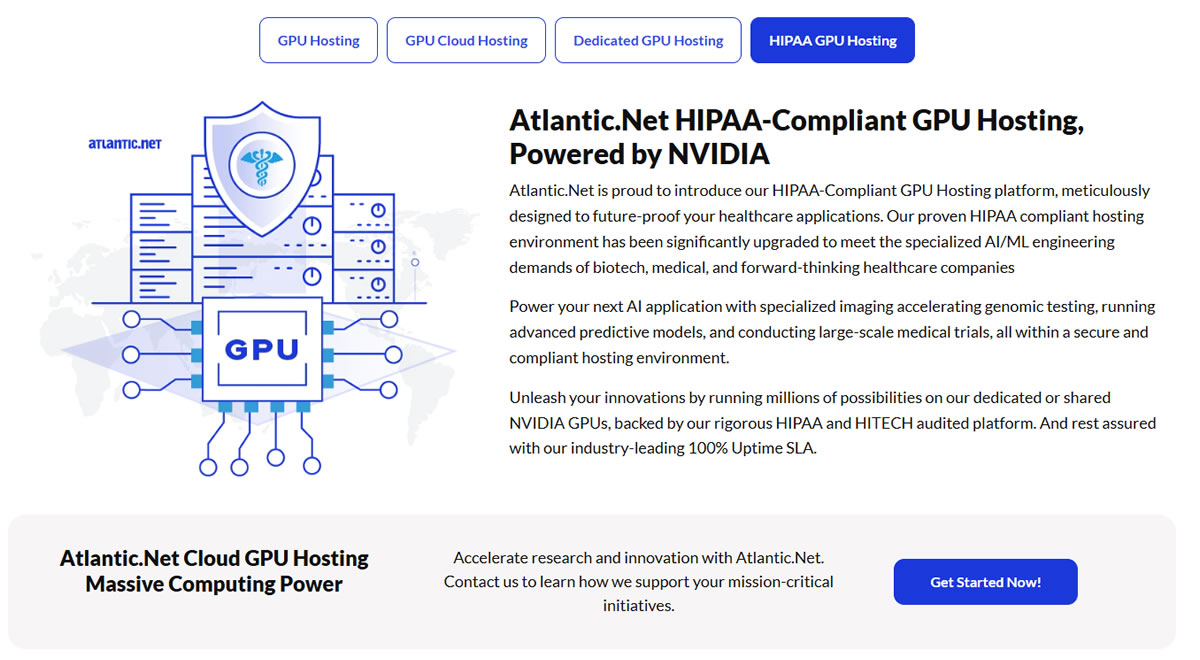
Atlantic.Net is the best GPU hosting provider for AI projects in regulated industries such as healthcare, finance, and legal services. The company offers NVIDIA H100 NVL and L40S GPU configurations on dedicated servers that are fully compliant with HIPAA, HITECH, PCI DSS, and SOC 2 frameworks. This makes it an ideal choice for businesses developing AI applications that handle sensitive personal or financial data.
In the healthcare industry, Atlantic.Net supports GPU workloads for medical image processing, diagnostic model training, and secure patient data handling. In financial services, use cases like fraud detection, credit scoring models, and real-time trading bots can be hosted with confidence under PCI-compliant environments. For legal tech, the platform is suitable for AI-powered contract analysis, legal research engines, and e-discovery tools where confidentiality is paramount.
Unlike general-purpose cloud platforms, Atlantic.Net provides tailored Business Associate Agreements (BAAs), role-based access controls, encrypted storage, and advanced firewalls—features critical for organizations operating under regulatory oversight.
Which GPU Hosting is Best for Startups?

Startups will benefit most from DigitalOcean, thanks to its developer-friendly interface, hourly billing, and fast deployment of GPU Droplets powered by NVIDIA H100, RTX 6000 Ada, and L40S. Its transparent pricing, one-click deployment options, and pre-built machine learning environments let teams get started in minutes—without the need for DevOps or complex configuration.
Vultr also caters well to startups by offering even more GPU options and global locations, but its interface is more advanced and may have a steeper learning curve for early-stage teams.
Which GPU Hosting Offers the Best Value for Money?
Vultr offers the best value for money in GPU hosting, thanks to its broad GPU lineup, hourly billing, and global infrastructure. You can choose from NVIDIA H100, A100, L40S, A40, A16, and even HGX B200 cards — often at significantly lower rates than traditional cloud providers. This flexibility allows developers and businesses to pay only for what they use, whether it’s training an AI model over a weekend or running an inference engine 24/7.
The platform supports both virtual machines and bare metal deployments, giving you cost-effective options for different workload intensities. For example, startups can launch an A40 instance for under $0.45/hour, while more intensive workloads can scale to H100 or multi-GPU configurations without long-term contracts.
Which Provider Offers the Most Flexible Scaling?
Vultr offers the most flexible GPU scaling model, with hourly billing, API-driven automation, and the ability to choose from multiple GPU tiers, including H100, A100, and L40S. Users can deploy, destroy, or reconfigure instances on demand, and the platform supports both virtual machines and bare metal deployments for different workload types.
DigitalOcean also offers flexible scaling, however it’s limited to VM-based GPU Droplets and lacks the hardware diversity and bare metal options Vultr provides.
Which GPU Host has the Most Data Center Locations?

Vultr leads in global presence, operating 32+ data center locations across North America, Europe, Asia, and Australia. This extensive network allows businesses to deploy GPU resources closer to end-users, reducing latency for globally distributed applications such as gaming, live video processing, or AI inference.
What is GPU Server Hosting?
GPU server hosting is a hosting service that provisions remote servers equipped with Graphics Processing Units (GPUs) to accelerate compute-intensive workloads. Unlike standard CPU servers, GPU servers process thousands of parallel operations, powering machine learning, 3D rendering, data analytics, video processing, and game streaming with significantly higher throughput.
These servers can be deployed as bare metal machines, cloud instances, or virtual environments, depending on the provider and workload design.
In hosting and cloud contexts, GPU hosting enables developers and enterprises to access high-performance computing without owning on-premise hardware. It reduces upfront investment, scales dynamically with demand, and streamlines the infrastructure required for large-scale AI and computational workloads.
GPU vs CPU vs TPU
To understand GPU hosting better, it helps to compare GPUs, CPUs, and TPUs across key attributes:
| Feature | CPU (Central Processing Unit) | GPU (Graphics Processing Unit) | TPU (Tensor Processing Unit) |
|---|---|---|---|
| Primary Use | General-purpose computing | Parallel processing for compute-heavy tasks | Specialized processing for machine learning models |
| Best For | Web servers, databases, OS-level tasks | AI/ML workloads, video rendering, simulations | TensorFlow-based AI training and inference |
| Architecture | Few powerful cores (optimized for sequential tasks) | Thousands of smaller cores (optimized for parallelism) | Matrix processing units (ASICs built for tensor operations) |
| Flexibility | Highly flexible, supports most software | Flexible with CUDA, TensorFlow, PyTorch, and others | Limited to certain ML frameworks, mostly TensorFlow |
| Performance (AI) | Low | High | Extremely high (within supported tasks) |
| Availability | Widely available on all hosting platforms | Available from most cloud/GPU hosting providers | Primarily available via Google Cloud |
| Ease of Use | Easiest to deploy and manage | Requires GPU-aware libraries and drivers | Requires integration with Google Cloud & TensorFlow stack |
Why GPU Hosting Matters?
GPUs balance flexibility and compute power, making them the most versatile choice for AI, machine learning, and high-performance computing workloads.
While CPUs remain essential for general-purpose hosting, and TPUs excel in TensorFlow-specific applications, GPU hosting delivers the best combination of scalability, speed, and platform flexibility across both cloud and dedicated environments.
What are the Criteria in Choosing the Right GPU Hosting?
Choosing the right GPU hosting provider starts with understanding your workload, resource demands, and budget scope.
- GPU Model and Performance – The GPU model defines computational capacity. High-end units such as NVIDIA H100, L40S, or A100 accelerate AI training and data-heavy workloads, while mid-range GPUs sustain inference, rendering, or analytics tasks at lower cost.
- Deployment Type – The hosting architecture determines control and efficiency. Cloud GPU instances offer quick provisioning and scalability; bare metal servers deliver maximum throughput and full hardware isolation; hybrid models balance both approaches.
- Scalability and Billing Flexibility – Leading providers enable on-demand scaling and hourly billing, allowing resources to expand or contract according to workload requirements. This optimizes cost efficiency and utilization.
- Data Center Proximity – Server location affects latency and throughput. Hosts such as Vultr and OVHcloud operate globally distributed data centers that reduce response times and improve application performance.
- Compliance and Security – Regulated workloads require compliant infrastructure. The best GPU hosts comply with HIPAA, PCI DSS, and GDPR, and implement encryption, access control, and continuous monitoring to protect sensitive data.
- Ease of Use and Developer Tools – Usability impacts deployment speed. Look for platforms that integrate APIs, support OS flexibility, and include prebuilt TensorFlow or PyTorch environments to simplify setup and development.
- Support and Management Services – Service scope influences reliability. Managed providers such as Liquid Web and Atlantic.Net monitor, maintain, and secure infrastructure, while DigitalOcean and Vultr grant developers full administrative control.
Should You Use GPU Server Hosting?
GPU server hosting isn’t for everyone. However if your projects demand high-performance computing, it’s often essential. If you’re running deep learning models, processing massive data sets, rendering 3D visuals, or building real-time AI applications, a traditional CPU-based server just won’t cut it. GPUs offer the parallelism and speed required to handle these workloads efficiently.
That said, GPU hosting also comes with higher costs and technical complexity. For small websites, static content, or lightweight backend processes, regular cloud-based or VPS hosting is more practical. But for teams building AI models, video platforms, financial simulations, or scientific tools, investing in GPU hosting will pay off in time saved, scalability, and model performance.
As the demand for AI, personalization, and real-time processing continues to grow, so too does the value of having the right GPU infrastructure behind your applications.