
TL;DR
Users typically opt for Linux hosting due to its reliability, affordability, and with the flexibility it offers in supporting various scripting languages and open-source technologies. While there are plenty of competitive players offering Linux hosting, ScalaHosting has beaten all of them to emerge the best overall Linux hosting solution based on our rating system.
Note: While our HostScore ratings provide a general overview of host performance, there are other factors you should consider for your specific needs. Our top hosting picks address this by offering tailored suggestions for different requirements, as demonstrated in this article.
ScalaHosting

ScalaHosting was founded in 2007 by Hristo Rusev and Vladislav Georgiev and is headquartered in Dallas, Texas. The company provides shared hosting, managed VPS hosting, cloud hosting, email hosting, and reseller hosting, with a clear focus on users who want more control than standard shared hosting allows. Its platform centers on SPanel, an in-house control panel built as a cPanel alternative, and SShield, a security system that monitors and blocks server-level threats. ScalaHosting also extends its ecosystem with tools such as SWordPress Manager and the SKAI AI assistant, giving it a stronger platform identity than many hosts that rely mainly on third-party software. This makes ScalaHosting stand out as a hosting provider that develops, manages, and improves much of its own hosting stack.
Supported Language
Key Features for Developers
Recommended for
HostScore
ScalaHosting Pros
- Excellent uptime and fast server performance confirmed through HostScore’s long-term monitoring, load tests, and recent benchmark experiments
- Affordable managed VPS hosting, often up to 40% cheaper than comparable managed VPS providers
- Anytime unconditional money-back guarantee
- Automated daily backups with seven restore points
- NVMe storage across all shared hosting plans for faster database and file operations
- Innovative in-house technologies including SPanel, SShield security, SKAI AI assistant, and SWordPress Manager
ScalaHosting Cons
- Renewal prices for shared and VPS plans are significantly higher than initial promotional rates
- No dedicated server / bare metal plans available for enterprise-scale workloads
Verpex

Founded in 2018 by a team with prior ventures later acquired by GoDaddy, Verpex offers cPanel-based cloud hosting with a focus on speed and security. Privately funded and fast-growing, the company now hosts over 300,000 websites on 1,200 servers. Its growth has been driven by competitive pricing, a strong support team, and a customer-first approach that appeals to freelancers, agencies, and small businesses worldwide.
Supported Language
Key Features for Developers
Recommended for
HostScore
Verpex Pros
- Budget-friendly entry pricing on shared and VPS hosting plans
- 45-day money-back guarantee on shared/reseller plans (longer than industry standard)
- Daily backup included in all shared hosting plans at no extra cost
- Unlimited free site migrations
- Choice of 8 global data centers across five continents
- Wide hosting selection including Windows, reseller, and managed servers
Verpex Cons
- Steep renewal pricing after the first term (up to 90% higher than intro rates)
- Short refund window on managed VPS (7 days compared to 30+ with some competitors)
InMotion Hosting
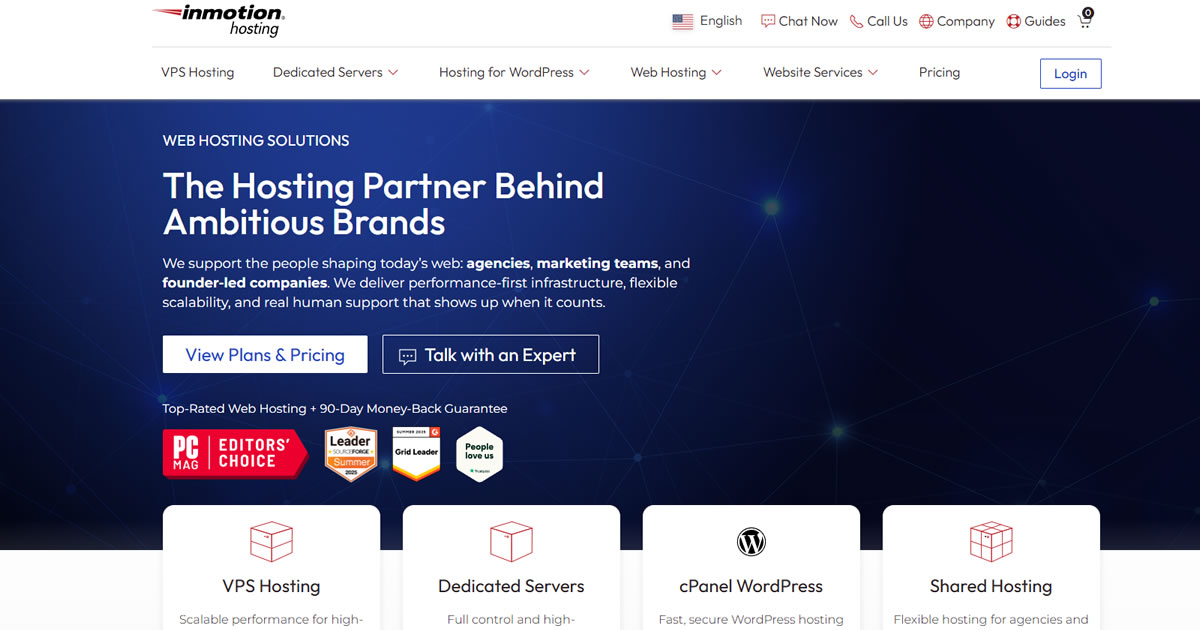
InMotion Hosting, founded in 2001 by Sunil Saxena and Todd Robinson in Los Angeles, has grown into a well-established U.S. hosting provider. Built by industry veterans, the company emphasizes reliable infrastructure, practical features, and customer-friendly support.
Supported Language
Key Features for Developers
Recommended for
HostScore
InMotion Hosting Pros
- Affordable entry pricing
- Developer stack on all shared hosting plans (Python/Node/Ruby, Git, SSH)
- Built-in hack, DDoS, and malware protection
- Long 90-day money back guarantee refund window (best in market)
- Free SSL, email, and site migration
InMotion Hosting Cons
- Lower shared hosting plans lack advanced speed features
- Higher renewal rates across shared, VPS, and reseller plans
- No Asia-based data center
- No Windows Server hosting option
GreenGeeks

Founded in 2008 by web hosting veteran Trey Gardner, GreenGeeks emerged in Santa Monica, California, with a pioneering mission: to make web hosting environmentally sustainable. Alongside Gardner, COO Kaumil Patel, with his extensive background in hosting operations, plays a key role in driving the company’s success. GreenGeeks sets itself apart with a strong commitment to the environment, using renewable energy credits to offset three times the power consumed by its clients’ websites. This innovative approach not only positions GreenGeeks as a leader in eco-friendly hosting but also underscores its dedication to making a meaningful environmental impact.
Supported Language
Key Features for Developers
Recommended for
HostScore
GreenGeeks Pros
- 300% green energy offset with RECs
- Affordable entry pricing for shared and WordPress hosting plans
- Free daily backup for all shared hosting plans
- Partnership with One Tree Planted plants a tree for every new hosting account
- Free website migration assistance
- Enhanced scalability options with VPS and dedicated plans
GreenGeeks Cons
- Higher renewal rates across shared and WordPress plans
- Slightly lackluster customer service, with complaints of limited support for customers transferring domains out of the platform
- No Windows Server hosting option
LiquidWeb

Founded in 1997 by Matthew Hill, Liquid Web has established itself as a leading player in the hosting and managed cloud services market, catering specifically to the needs of businesses, developers, and professionals. With its headquarters in Lansing, Michigan, the company has grown to serve over 45,000 customers in 150 countries, managing more than 500,000 sites globally. Liquid Web is renowned for its industry-leading customer service, exemplified by its 59-second support guarantee, and its commitment to delivering reliable, high-performance hosting solutions. The company’s offerings range from managed WordPress and WooCommerce hosting to dedicated servers, VPS hosting, and custom enterprise solutions. Liquid Web’s focus on security and compliance, including HIPAA and PCI-compliant hosting, makes it a trusted partner for industries with stringent regulatory requirements. Over the years, Liquid Web has earned numerous accolades for its innovation and customer satisfaction, reinforcing its position as a trusted provider in the competitive hosting landscape.
Supported Language
Key Features for Developers
Recommended for
HostScore
LiquidWeb Pros
- Powerful enterprise hosting solutions with great scalability
- 100% network uptime, backed by detailed Service Level Agreement (SLA)
- Excellent customer support – 59-Second support response guarantee
- Self-operated data centres – Higher degree of security and data integrity compared to providers renting space from third-parties
- PCI-Compliant and HIPAA-Compliant hosting servers available
- Cheaper cloud VPS plan (starts at $5/mo) now available
LiquidWeb Cons
- Does not provide low-cost shared hosting plans
- No Asia-based data center
Digital Ocean

Established in 2011, DigitalOcean was founded by Ben Uretsky, Moisey Uretsky, Mitch Wainer, Jeff Carr, and Alec Hartman. Originating from their prior venture, ServerStack, DigitalOcean was crafted to simplify cloud computing for software developers. With a mission to empower developers in building, deploying, and scaling cloud applications effortlessly, DigitalOcean has grown substantially, offering accessible, high-performance, and cost-effective cloud solutions tailored to the needs of software developers and small-scale startups.
Supported Language
Key Features for Developers
Recommended for
HostScore
Digital Ocean Pros
- Outstanding server uptime and speed performance
- Competitive and flexible pricing model
- Choice of 15 distributed data centers
- Highly configurable virtual machines
- Built-in alert system for resource thresholds or critical issues
Digital Ocean Cons
- Charges apply for automated backups
- Unencrypted backups
- Only suitable for advanced users
- Less user-friendly for team operations
What is Linux Hosting?
Linux Hosting is a web hosting solution that operates on servers running the Linux operating system, an open-source platform renowned for its security and flexibility. Linux hosting supports a wide range of web technologies, such as PHP, MySQL, and Apache, making it ideal for hosting websites built with these technologies. Typically, Linux hosting plans come with popular control panels like cPanel or Plesk – which simplify the management of hosting resources, domains, and websites.
The open-source model not only ensures that Linux Hosting is cheap but also allows for extensive customization, offering users a reliable, secure, and highly adaptable hosting option. Combine this factor with strong community support and compatibility with popular web applications, Linux Hosting remains a top choice among users seeking a powerful and affordable web hosting solution.
Linux vs Windows Hosting
Linux hosting excels with open-source technologies, such as PHP, Perl, Python, and MySQL; while Windows hosting is essential for ASP.NET, MSSQL applications, and Access database.
| Aspect | Linux Hosting | Windows Hosting |
|---|---|---|
| Operating System Compatibility | Best for PHP, Perl, Python, MySQL | Required for ASP.NET, MSSQL, Access |
| Performance and Reliability | High efficiency and stability, especially under heavy loads | Good, with improvements in stability but may be less efficient in resource management |
| Security | Frequent, community-driven updates for security; perceived as more secure | Comprehensive security features, but a more common target for attacks |
| Ease of Use | cPanel management; might have a learning curve for those new to Linux | Plesk or other Windows-based tools; familiar to Windows users |
| Cost-Effectiveness | Generally more cost-effective due to no OS licensing fees | Higher costs due to licensing fees for Windows Server and other Microsoft software |
| Flexibility and Customization | High, with the ability to modify and customize the open-source software | Less, due to proprietary nature |
Factors to Consider When Choosing a Linux Hosting
When considering the best Linux hosting option, you should assess your specific needs, such as the type of website they’re planning to host, expected traffic, budget, and other technical requirements.
Below are eight key factors to consider.
- Performance and Reliability: High uptime rates and fast server response times are critical. The best Linux hosting providers invest in high-quality hardware and software optimizations to ensure that websites are always available and load quickly for users.
- Security: Linux is known for its robust security features. The best Linux hosting services further enhance this with regular updates and active security measures such as firewalls, intrusion detection systems, and malware scanning to protect websites from threats.
- Support for Technologies: Linux servers are favored for their excellent support for a wide range of programming languages (such as PHP, Python, and Ruby) and databases (such as MySQL and PostgreSQL).
- Scalability: As websites grow, so do their hosting needs. The best hosting providers offer easy scalability options, allowing customers to upgrade their server resources (RAM, CPU, bandwidth, etc.) without significant downtime or migration hassles.
- Pricing and Value: While cost is a significant factor, the best Linux hosting providers offer competitive pricing without compromising on the quality of their services. This includes transparent pricing models, cost-effective plans with generous resources, and no hidden fees.
- User-Friendly Management Tools: Even though Linux can be complex, the best providers offer user-friendly control panels (such as cPanel or Plesk) that make it easy for users to manage their hosting environment.
- Customer Support: Excellent customer support is essential, especially for users who may not have technical expertise. Top Linux hosting services provide 24/7 support via multiple channels (phone, chat, email) and have knowledgeable staff to assist with any issues.
- Sustainability: An increasing number of hosting shoppers are also considering the environmental impact of their hosting choices. Providers that use renewable energy sources or participate in carbon offsetting programs are often preferred.

