

OVHcloud alternatives for regulated and performance-sensitive workloads include Atlantic.Net, Liquid Web, RoseHosting, ScalaHosting, and Kamatera. These providers address compliance, performance consistency, and operational support in ways that differ from OVH’s scale-first infrastructure model.
OVHcloud is widely used for bare metal, private cloud, and large-scale deployments, particularly by enterprises that prioritize sovereignty and cost-efficient performance. Its infrastructure is certified across multiple compliance frameworks, making it a strong option for organizations that want direct control over regulated environments.
That said, regulated and performance-critical workloads often demand more than compliant infrastructure alone. Businesses may require audit-aligned hosting, managed safeguards, predictable performance under sustained load, or hands-on support. This is where OVH alternatives become relevant, depending on workload sensitivity and operational maturity.
Why Businesses Look for OVH Alternatives?
Businesses look for OVH alternatives when infrastructure scale is not the primary concern. While OVHcloud excels at delivering customizable, high-performance infrastructure, it places more responsibility on customers to design, manage, and document compliance controls.
For regulated workloads, this can introduce operational friction. Teams may need clearer compliance guidance, managed security layers, or hosting environments designed specifically around frameworks such as HIPAA or PCI DSS, rather than infrastructure that is compliant in principle but hands-off in practice.
Performance-sensitive systems also shift the evaluation criteria. Consistent latency, predictable resource allocation, and responsive support often matter more than maximum throughput or lowest cost per core. Providers that emphasize managed reliability or guaranteed resources can therefore be a better fit than large-scale infrastructure platforms.
What Counts as a Regulated or Performance-Sensitive Workload?
Regulated and performance-sensitive workloads are systems where data handling, uptime, and infrastructure behavior must meet defined standards. These workloads are typically subject to external requirements or business risk that makes infrastructure predictability critical.
Regulated workloads often include healthcare platforms subject to HIPAA (in the United States), payment-related systems operating under PCI DSS scope, and enterprise or government-adjacent applications that require audit trails and documented controls. In these cases, hosting decisions are influenced by compliance alignment, documentation, and support readiness.
Performance-sensitive workloads include production databases, transactional backends, SaaS platforms with sustained traffic, and eCommerce systems where latency and downtime directly affect revenue. These environments prioritize consistency, isolation, and support responsiveness over burst performance or short-term cost savings.
Because OVHcloud focuses on scale, automation, and cost efficiency, businesses running these workloads often evaluate hosting providers that offer stronger guarantees, managed support, or clearer compliance positioning.
1. Atlantic.Net

Website: https://www.atlantic.net/pci-compliant-hosting/
Atlantic.Net positions itself as a compliance-first hosting provider rather than a large-scale infrastructure platform. Compared to OVHcloud, which focuses on flexible, self-managed infrastructure, Atlantic.Net delivers audited hosting environments designed specifically for regulated workloads.
Atlantic.Net offers compliance-aligned cloud, dedicated, and bare metal hosting with support for frameworks such as HIPAA, PCI DSS, and SOC. Instead of leaving compliance controls entirely to the customer, the company provides infrastructure, safeguards, and guidance that are already aligned with regulatory expectations. This reduces the operational burden often associated with running regulated workloads on infrastructure-only providers like OVH.
Atlantic.Net is best suited for organizations that value compliance readiness and audit alignment over infrastructure scale or cost optimization. While OVHcloud excels at sovereign, customizable deployments, Atlantic.Net appeals to healthcare providers and payment processors that want clearer compliance boundaries and hands-on support.
What We Like
- Compliance-first hosting model with HIPAA and PCI-aligned environments
- Audited, managed infrastructure designed for regulated workloads
- Clear positioning for healthcare and payment-related systems
Drawbacks
- Higher entry cost than infrastructure-focused providers like OVHcloud
- Less emphasis on large-scale or highly customized deployments
2. LiquidWeb
Website: https://www.liquidweb.com/pci/
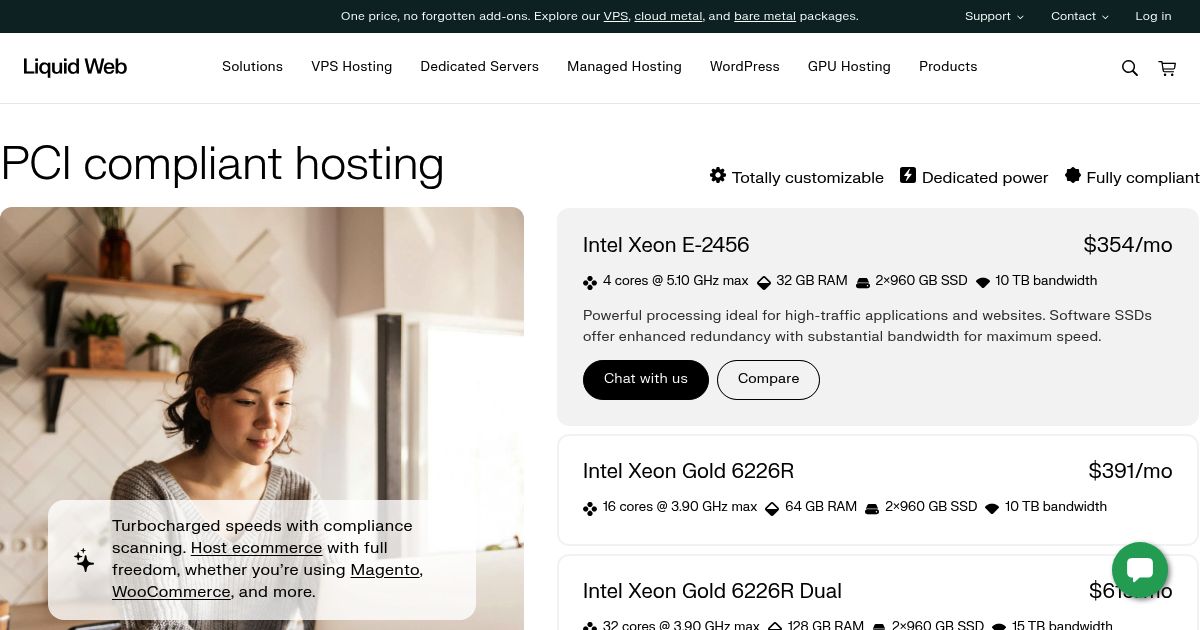
Liquid Web positions itself as a managed hosting provider for businesses that prioritize performance reliability and operational support over infrastructure scale. Compared to OVHcloud’s self-managed model, Liquid Web focuses on delivering performance consistency through managed environments and hands-on support.
Liquid Web provides managed dedicated servers and private cloud hosting designed to support performance-critical and regulated workloads. Its infrastructure is backed by 100% SLA-driven uptime commitments and an experienced support team familiar with compliance-related requirements. This makes Liquid Web a practical alternative for businesses that want strong performance without managing infrastructure directly.
Overall, we think Liquid Web is best suited for eCommerce platforms, agencies, and production systems. While OVHcloud offers more flexibility and global scale, Liquid Web appeals to teams that prefer managed performance and compliance support over customization.
What We Like
- Fully managed dedicated and private cloud hosting
- Strong uptime SLAs and responsive support
- Experience supporting performance-critical and regulated environments
Drawbacks
- Higher pricing compared to self-managed infrastructure
- Limited server locations outside North America and Europe
3. RoseHosting

RoseHosting focuses on delivering fully managed Linux hosting with predictable performance rather than large-scale infrastructure flexibility. In contrast to OVHcloud’s scale-driven offerings, RoseHosting emphasizes guaranteed resources and performance consistency.
The company provides managed dedicated servers and VPS hosting backed by NVMe storage and dedicated resource allocation. Its environments are designed for performance-sensitive Linux workloads where consistent CPU and memory access matter more than elastic scaling. HIPAA-ready hosting options are also available for regulated use cases.
From our market research, we strongly recommend RoseHosting for businesses running databases, backend services, or high-load Linux applications that require stable performance under sustained workloads.
What We Like
- Fully managed Linux hosting with dedicated resources
- Strong performance consistency for sustained workloads
- Long-standing reputation and technically competent support
Drawbacks
- Higher cost compared to unmanaged VPS providers
- Limited data center locations compared to OVHcloud
4. ScalaHosting

Website: https://www.scalahosting.com/
ScalaHosting positions itself as a managed VPS provider for teams that want predictable performance and security controls without managing servers directly. Compared to OVHcloud’s infrastructure-centric approach, ScalaHosting focuses on simplifying server management while maintaining performance consistency.
ScalaHosting offers managed VPS and cloud hosting with its proprietary sPanel control panel and SShield security system. While its infrastructure is not compliance-certified by default, it can be configured to support regulated workloads with proper setup. This makes ScalaHosting a practical alternative for businesses that need reliability and security, but not enterprise-grade compliance frameworks.
ScalaHosting is best suited for small and mid-sized teams that want managed performance, built-in security, and easier administration than OVHcloud provides. It trades OVH’s scale and flexibility for usability and cost efficiency.
What We Like
- Managed VPS hosting with simplified server control
- sPanel and SShield security tools included
- More affordable than enterprise managed hosting providers
- Excellent performance in our recent server load and benchmark tests
Drawbacks
- Compliance support requires configuration and customer responsibility
- Renewal pricing can be higher than promotional rates
5. Kamatera

Website: https://www.kamatera.com/
Kamatera offers highly configurable cloud and bare metal infrastructure designed for businesses that want full control over performance and deployment. Like OVHcloud, Kamatera follows an infrastructure-first model, but with greater flexibility and faster provisioning.
Kamatera provides customizable servers with fine-grained control over CPU, RAM, and storage, along with a wide selection of global data center locations. While the platform supports compliance-capable infrastructure, implementing regulatory controls and audits remains the customer’s responsibility.
Kamatera is best suited for engineering-led teams and SaaS platforms that want OVH-level control with more flexible scaling options. It appeals to users who value customization and global reach over managed compliance or guided support.
What We Like
- Highly customizable cloud and bare metal servers
- Global data center presence
- Fast deployment and scalable infrastructure
Drawbacks
- No built-in compliance guidance or auditing support
- Requires in-house expertise to manage regulated workloads
Setting up hosting can be confusing. That’s why we created HostScore Setup Help, a done-for-you service for getting your hosting configured the right way.
We help with SSL installation, DNS & nameserver setup, WordPress install or migration, and security tuning. One-time fee. Backed by a 100% refund guarantee.
Explore Our ServicesComparison: OVHcloud vs Alternatives
Providers listed above differ in how they balance compliance readiness, performance predictability, and operational responsibility. OVHcloud focuses on large-scale, self-managed infrastructure, while the alternatives below emphasize managed environments, compliance alignment, or predictable performance under sustained workloads.
The following table compares each option based on hosting model, compliance positioning, performance characteristics, and management level. This makes it easier to see which providers prioritize infrastructure control and which focus on operational support and regulatory alignment.
| Provider | Hosting Model | Compliance Positioning | Performance Characteristics | Management Level | Best Fit For |
|---|---|---|---|---|---|
| OVHcloud | Bare Metal, Cloud Infrastructure | Infrastructure certified (ISO, SOC, PCI-capable) | High raw performance, scale-focused | Self-managed | Enterprises needing sovereign, large-scale infrastructure |
| Atlantic.Net | Managed Infrastructure, Bare Metal | Compliance-first (HIPAA, PCI, SOC aligned) | Stable, predictable performance | Fully managed | Regulated workloads needing audit-aligned hosting |
| Liquid Web | Managed Infrastructure | Compliance-supported (HIPAA-ready, PCI-capable) | SLA-backed, production-grade reliability | Fully managed | Ecommerce and regulated systems needing strong support |
| RoseHosting | Managed VPS, Managed Infrastructure | HIPAA-ready environments | Dedicated resources, consistent performance | Fully managed (Linux) | Performance-sensitive Linux workloads |
| ScalaHosting | Managed VPS | Compliance-capable with configuration | Predictable VPS performance | Managed | SMBs needing security and easier server management |
| Kamatera | Cloud Infrastructure, Bare Metal | DIY compliance (infrastructure capable) | Customizable, elastic performance | Self-managed | Engineering teams building custom regulated stacks |
What OVH Does Well; and Where These Alternatives Differ?

OVHcloud excels at delivering large-scale infrastructure with strong performance characteristics. Its bare metal and cloud offerings appeal to organizations that value sovereignty, customization, and cost-efficient access to high-performance hardware.
This infrastructure-first model works well when teams have the expertise to design, manage, and document their own environments. OVH provides the building blocks, but operational responsibility remains largely with the customer.
The alternatives in this guide take a different approach. Providers like Atlantic.Net and Liquid Web emphasize managed environments and compliance alignment, while others prioritize predictable performance or simplified server management. These differences matter when workloads become regulated or business-critical, and when operational readiness outweighs raw infrastructure scale.
A Note on Compliance and Performance Expectations
Compliance and performance are often misunderstood in hosting decisions. Compliance is not a binary feature, and performance is not defined by peak benchmarks alone.
Regulated workloads require clear responsibility boundaries, documentation, and support readiness. Performance-sensitive systems prioritize consistency, isolation, and uptime under sustained load rather than short-term bursts.
These expectations explain why infrastructure scale alone does not always meet the needs of regulated or performance-critical workloads.
Final Conclusion: OVH Alternatives for Regulated and Performance-Sensitive Workloads
OVH alternatives for regulated and performance-sensitive workloads exist because infrastructure scale alone does not address every operational or compliance requirement. While OVHcloud excels at delivering high-performance, sovereign infrastructure, other providers prioritize managed compliance, predictable performance, or clearer responsibility boundaries.
Choosing the right alternative depends on how regulated the workload is, how consistent performance needs to be, and how much operational responsibility the team can realistically manage.

