The best bare metal hosting solutions for 2025 are Atlantic.Net, InMotion Hosting, Ultahost, Liquid Web, and KnownHost. These providers offer strong compute performance, predictable resource allocation, and direct control over hardware without a virtualization layer.
Bare metal hosting provides dedicated CPU, RAM, storage, and network throughput for applications that cannot afford noisy-neighbor issues or shared hypervisor overhead. Buyers usually compare these servers based on processor type, memory configuration, storage architecture, bandwidth limits, and management options.
Atlantic.Net leads our list with its compliance-focused infrastructure and high-isolation network setup. InMotion Hosting stands out for its 10Gbps unmetered bandwidth and automation-friendly tooling. Ultahost offers the lowest starting price with modern DDR5 and Ryzen hardware, making it ideal for long-term value seekers. Liquid Web emphasizes rapid provisioning and fully managed options, while KnownHost supports full-control deployments through its built-to-order unmanaged dedicated servers.
This guide explains how each provider performs, how their hardware differs, and which platform fits specific workloads such as AI/LLM processing, high-traffic sites, and regulated environments.
| Web Host | CPU | Memory | Storage | Bandwidth / Port | Starting Price | Key Features & Notes |
|---|---|---|---|---|---|---|
| Atlantic.Net | Intel Xeon E-2236, 3.4GHz | 64GB DDR4 | 2×480GB SSD | 20TB @ 1Gbps | $138.00/mo | 100% Uptime SLA; Intel or AMD EPYC options; custom builds. |
| InMotion Hosting | Intel Xeon Silver 4214, 3.20GHz | 192GB DDR4 | 2×1TB NVMe SSD | Up to 10Gbps Unmetered | $279.99/mo | Commercial Class; US/EU locations; free Ansible Control Node. |
| Ultahost | Intel Xeon 3-1265L V3, 2.5GHz | 16GB DDR5 | 1×256GB NVMe SSD | 300Mbps Port, Unlimited Traffic | $74.80/mo | Free monthly management; 100% uptime; supports VMware/Proxmox. |
| LiquidWeb | Intel E-2134, 3.5 GHz | 16GB DDR4 | 2×480GB SSD | 10TB | $88.00/mo | Self-managed or fully managed; DDoS protection included. |
| KnownHost | Intel Xeon E-2224, 3.4GHz | 16GB DDR4 | 240GB SSD | 10TB @ 1Gbps | $109.00/mo | Built-to-order; Atlanta DC; DDoS protection + IPMI. |
1. Atlantic.Net
Website: https://www.atlantic.net/bare-metal-servers/
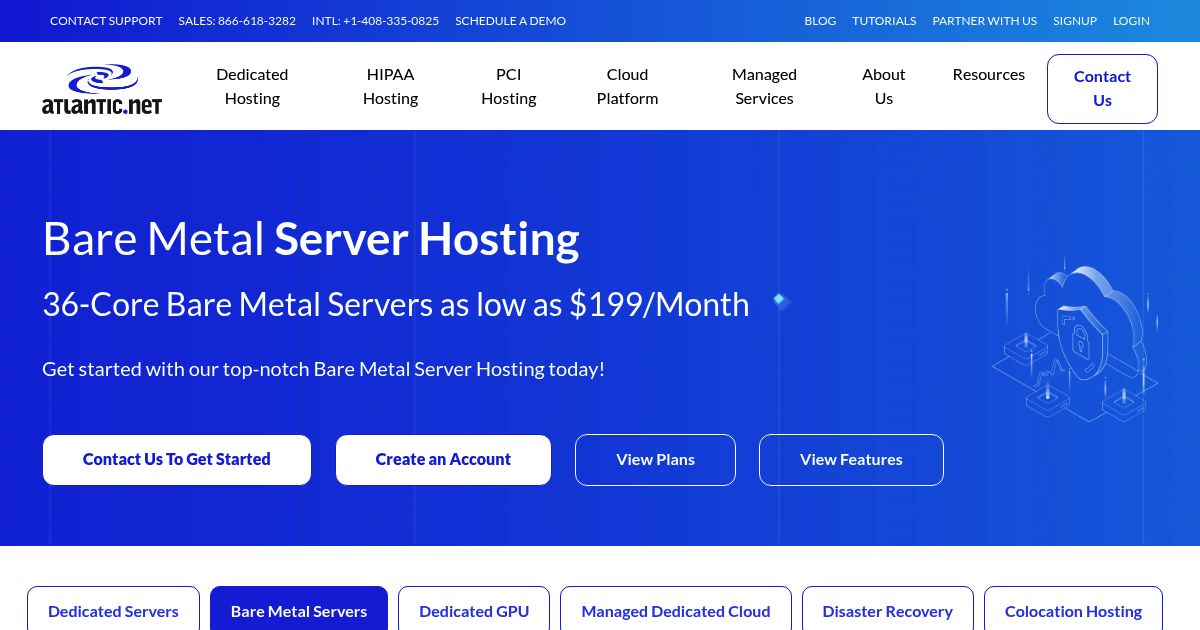
Atlantic.Net offers bare metal servers designed for regulated workloads and sensitive applications. Their infrastructure supports HIPAA- and PCI-ready deployments, and the platform uses Layer 2 network virtualization to isolate traffic at the hardware level.
The company provides both Intel Xeon and AMD EPYC processors, with EPYC favored for compute-intensive tasks such as analytics, large databases, and AI or LLM workloads. Even the entry configuration includes 64GB DDR4 RAM, and custom server builds are available for buyers who need more tailored hardware.
Why Atlantic.Net is our #1 pick for compliance and isolation?
Atlantic.Net provides users full control over their servers by shipping machines without a pre-installed hypervisor. This reduces overhead and allows teams to configure their operating system and stack from scratch. Optional managed services, such as firewalls, intrusion detection, and server management, add flexibility for organizations that want bare metal performance with support coverage. This balance of hardware isolation, compliance support, and customization makes Atlantic.Net our top recommendation for security-focused deployments.
| Pros | Cons |
|---|---|
| Supports HIPAA- and PCI-ready deployments | Entry price is higher than some competitors |
| Provides strong Layer 2 network isolation | Data centers are mainly US-based |
| Offers Intel Xeon and AMD EPYC options | Managed services add to cost |
| Allows full OS and stack control (no hypervisor) | |
| Custom bare metal builds available |
2. InMotion Hosting

Visit Online: https://www.inmotionhosting.com/bare-metal-servers/
InMotion Hosting provides Commercial Class bare metal servers built for traffic-heavy applications and data-intensive workloads. Their platform offers up to 10Gbps unmetered bandwidth across all listed plans, making it one of the most generous network allowances in this category. The hardware lineup includes high core/thread CPU options, NVMe SSD storage, and the ability to deploy in either US or EU data centers. Technical users also benefit from a free Ansible Control Node with their first server, which accelerates automated deployments.
Why InMotion Hosting stands out for network capacity?
InMotion Hosting supports enterprise workloads that demand consistent throughput and predictable resource allocation. Their unmetered 10Gbps design gives high-traffic sites and API-heavy applications room to scale without facing bandwidth penalties.
Combined with strong CPU configurations and automation tooling, InMotion Hosting offers a reliable choice for businesses that outgrow standard dedicated hosting and need sustained network performance.
| Pros | Cons |
|---|---|
| Provides up to 10Gbps unmetered bandwidth | No data centers outside US and EU |
| Includes free Ansible Control Node | Some workloads may need GPU options not offered |
| Supports high core/thread CPU configurations. |
3. Ultahost

Visit Online: https://www.ultahost.com/
Ultahost offers some of the most affordable bare metal pricing in this category while still delivering modern hardware. Their dedicated servers feature DDR5 RAM, NVMe storage, and high-performance CPUs including AMD Ryzen 9 and dual AMD EPYC options.
All Ultahost dedicated plans include unlimited bandwidth, a 100% uptime guarantee, and free monthly server management. Deployment is also quick, with Germany-based servers often provisioned in under 40 minutes.
Why Ultahost delivers strong value for cost-conscious users?
Ultahost keeps its pricing low by offering long-term billing cycles and streamlined provisioning. The combination of modern components, unlimited traffic, and included management creates a value proposition few competitors match at similar price points. Users who want dedicated compute without committing to high monthly fees will find Ultahost a practical entry point into bare metal hosting.
| Pros | Cons |
|---|---|
| Offers the lowest starting price among our picks | Unlimited bandwidth runs on shared network ports |
| Includes free monthly management | Fewer compliance-focused features. |
| Provides DDR5 RAM and modern Ryzen/EPYC CPUs | Hardware customization is limited. |
4. LiquidWeb

Visit Online: https://www.liquidweb.com/
Liquid Web offers bare metal servers aimed at users who need rapid activation and strong support coverage. Their lineup includes both Intel and AMD platforms, with NVMe storage and 10TB bandwidth on all plans. A key advantage is the option to choose between self-managed or fully managed service levels. Liquid Web emphasizes raw performance by deploying servers with no virtualization layer, which helps eliminate overhead for compute-heavy workloads. Although they claim fast provisioning (typically 40 minutes), our recent experience showed delays on cloud server activation, suggesting the timeline may vary.
Why LiquidWeb bare metal server suits performance-first deployments?
Liquid Web appeals to buyers who want control over server management while maintaining access to expert support when needed. The no-virtualization design benefits HPC, gaming, and enterprise applications that depend on direct hardware access. Combined with multiple global locations and flexible management plans, Liquid Web remains a strong pick for teams that value performance and operational flexibility.
| Pros | Cons |
|---|---|
| Offers fast provisioning (as claimed) | Our recent onboarding took longer than expected |
| Removes virtualization overhead for raw performance | Pricing is higher for top-tier plans |
| Uses NVMe storage with 10TB bandwidth | Initial configurations may need manual tuning |
| Has strong support reputation |
5. KnownHost

Visit Online: https://www.knownhost.com/
KnownHost focuses on built-to-order unmanaged dedicated servers that give users complete control over their software stack (though they also offer managed dedicated hosting plans). Their hardware lineup spans modern AMD Ryzen, Intel Xeon, and AMD EPYC processors, with predictable provisioning times and strong baseline configurations.
All KnownHost’s dedicated servers include a /29 IP allocation (five usable addresses), IPMI access, and 10TB to 30TB monthly bandwidth depending on the model. While all plans are delivered from their Atlanta data center, KnownHost maintains a strong reputation for uptime and responsive support.
Why KnownHost is ideal for technical users?
KnownHost suits teams that prefer to configure and maintain their servers independently. Full root access, customizable builds, and transparent hardware options make it a practical choice for developers, system administrators, and businesses that want maximum control. Its positive user feedback and consistent reliability further reinforce KnownHost as a dependable unmanaged bare metal provider.
| Pros | Cons |
|---|---|
| Builds servers to order with modern CPUs | All servers are in a single Atlanta data center |
| Includes a /29 IP block with each server | Not ideal for buyers needing compliance frameworks. |
| Well-regarded for uptime and reliability |
Setting up hosting can be confusing. That’s why we created HostScore Setup Help, a done-for-you service for getting your hosting configured the right way.
We help with SSL installation, DNS & nameserver setup, WordPress install or migration, and security tuning. One-time fee. Backed by a 100% refund guarantee.
Explore Our ServicesBare Metal Server Plans Compared
| Web Host | CPU | Memory | Storage | Bandwidth / Port | Starting Price | Key Features & Notes |
|---|---|---|---|---|---|---|
| Atlantic.Net | Intel Xeon E-2236, 3.4GHz | 64GB DDR4 | 2×480GB SSD | 20TB @ 1Gbps | $138.00/mo | 100% Uptime SLA; Intel or AMD EPYC options; custom builds. |
| InMotion Hosting | Intel Xeon Silver 4214, 3.20GHz | 192GB DDR4 | 2×1TB NVMe SSD | Up to 10Gbps Unmetered | $499.99/mo | Commercial Class; US/EU locations; free Ansible Control Node. |
| Ultahost | Intel Xeon 3-1265L V3, 2.5GHz | 16GB DDR5 | 1×256GB NVMe SSD | 300Mbps Port, Unlimited Traffic | $74.80/mo | Free monthly management; 100% uptime; supports VMware/Proxmox. |
| LiquidWeb | Intel E-2134, 3.5 GHz | 16GB DDR4 | 2×480GB SSD | 10TB | $88.00/mo | Self-managed or fully managed; DDoS protection included. |
| KnownHost | Intel Xeon E-2224, 3.4GHz | 16GB DDR4 | 240GB SSD | 10TB @ 1Gbps | $109.00/mo | Built-to-order; Atlanta DC; DDoS protection + IPMI. |
Each listed bare metal server provider excels in different areas, from compute performance and bandwidth to compliance and full-control deployments. The right choice depends on the specific workload and operational needs.
With the core specs compared, we can now examine which provider fits each real-world scenario in our next section.
Which bare metal host is best for AI, LLMs, and compute-intensive workloads?

The best bare metal host for AI, LLMs, and compute-heavy workloads is Atlantic.Net, followed closely by LiquidWeb for users who prioritize core count, memory capacity, and direct hardware access. AI and LLM workloads rely on high parallelism, fast storage, and low overhead. These are the areas where the two providers align well.
Atlantic.Net (higher tiers) offers AMD EPYC processors with up to 64 cores and supports GPU-powered dedicated servers that can be added to bare metal deployments. Their range includes NVIDIA® L40S for versatile AI workloads and the high-end H100 NVL for large-scale training and inference. Combined with their Layer 2 network isolation and HIPAA/PCI-ready infrastructure, Atlantic.Net suits teams running regulated AI pipelines, LLM fine-tuning, vector search systems, and other compute-intensive workloads.
Liquid Web, on the other hand, removes the virtualization layer entirely, giving compute processes direct access to hardware without hypervisor overhead. This benefits CPU-bound tasks and HPC-style workloads. Their NVMe storage and availability of AMD Ryzen processors help maintain fast I/O during model loading and batch processing.
Which bare metal host is best for high-traffic or bandwidth-heavy sites?
The best bare metal host for high-traffic and bandwidth-intensive workloads is InMotion Hosting, thanks to its unmetered 10Gbps network across all Commercial Class plans. This setup supports large-scale applications, busy eCommerce stores, API-driven platforms, and multimedia sites that require steady throughput without worrying about monthly transfer caps. NVMe storage and high core/thread processors further help maintain fast response times during traffic spikes.
Ultahost is another strong option for high-bandwidth environments because it offers unlimited traffic on all dedicated servers. While network ports vary from 300Mbps to 2Gbps, the lack of transfer limits provides stable cost predictability for projects with fluctuating or unpredictable traffic patterns. Businesses that want a lower-cost alternative to InMotion Hosting often find Ultahost more accessible for long-term usage.
Which bare metal host is best for regulated industries (HIPAA, PCI, finance)?
Atlantic.Net is the clear choice for regulated workloads because it supports HIPAA- and PCI-ready deployments, offers Layer 2 traffic isolation, and provides optional managed security services like firewalls and intrusion detection. Their infrastructure aligns with the needs of healthcare systems, fintech platforms, and compliance-heavy enterprises that require strict control and validated processes. The ability to deploy custom hardware and GPU-powered configurations also suits organizations running sensitive AI-driven analysis.
Which bare metal provider offers the best value for the money?
The provider that delivers the strongest overall value is Ultahost. Their entry pricing is the lowest among our picks, and long-term billing cycles make high-core and DDR5-equipped servers accessible to smaller teams. Free monthly management reduces the operational burden for buyers who want bare metal performance but do not have in-house systems administrators. Unlimited bandwidth also keeps monthly expenses predictable for active production workloads.
Which bare metal host is best for users who want unmanaged, full-control deployments?
The best choice for full-control deployments is KnownHost, as all unmanaged dedicated servers come with full root access, IPMI, and hardware that is built to order. Their configurations span Ryzen, Xeon, and EPYC options, giving technical users the flexibility to match workloads with exact hardware profiles.
KnownHost’s consistent uptime and responsive support further enhance reliability for teams that handle their own stack management.
What is Bare Metal Hosting and How Does It Work?
Bare metal hosting provides a physical server dedicated entirely to one user, with no virtualization layer or shared hypervisor. This structure gives applications direct access to CPU cores, RAM (memory), and storage, allowing workloads to run without neighboring tenants competing for resources. Because the environment is single-tenant, performance remains consistent, and users have full control over how the operating system, software stack, and security layers are configured.
Bare metal servers are commonly used for high-performance computing, AI and machine learning pipelines, large databases, video processing, and enterprise applications that require predictable hardware behavior. Unlike cloud servers where workloads can shift between nodes, bare metal resources stay fixed on a single machine until the user makes deliberate hardware or configuration changes. This model suits organizations that prioritize stability, compliance, and raw compute speed over elastic scaling.
How is bare metal different from VPS or cloud servers?
Bare metal differs from VPS hosting because it eliminates the hypervisor that divides hardware into virtualized slices. A VPS shares CPU, RAM, and storage with multiple tenants, which introduces variability based on how neighbors consume resources. Bare metal avoids this issue entirely by giving all physical resources to one user.
Compared to cloud hosting, bare metal server does not offer instant vertical scaling or automated failover. Cloud workloads can expand or contract based on demand, while bare metal requires manual hardware adjustments or migrations. However, bare metal provides more consistent CPU performance, better I/O throughput, and full root-level customization. Organizations choose between the two based on whether they value absolute control and predictability (bare metal) or flexibility and elasticity (cloud).
Pros & cons of choosing a bare metal server
Bare metal servers offer predictable, single-tenant performance but require more operational responsibility than cloud or VPS hosting. They suit workloads that benefit from full hardware control, high compute throughput, and strict isolation.
| Pros | Cons |
|---|---|
| Delivers predictable, dedicated performance. | Scaling requires manual upgrades or migrations. |
| Removes virtualization overhead. | Provisioning is slower than cloud servers. |
| Supports full OS and stack customization. | Higher cost for high-core CPUs or GPU add-ons. |
| Fits HPC, AI, analytics, and database workloads. | Requires stronger server management skills. |
| Provides isolation for compliance-sensitive deployments. | Limited elasticity compared to cloud environments. |
Do you need managed or unmanaged bare metal hosting?
Managed bare metal hosting suits teams that want dedicated hardware without handling system updates, security patches, monitoring, or troubleshooting. Providers like InMotion Hosting and Ultahost include management options that reduce operational overhead and help non-specialist teams maintain a stable production environment. Managed servers also benefit organizations that need predictable support or operate under strict uptime requirements.
Unmanaged bare metal hosting is ideal for developers, sysadmins, and technical teams who prefer full control of the environment. Providers like KnownHost support this model by giving users root access, IPMI, customizable hardware builds, and complete freedom over how the system is configured. This approach is cost-effective but requires expertise in server hardening, performance tuning, and ongoing maintenance.
How do you choose the right bare metal hardware?
Choosing the right bare metal hardware starts with identifying the workload.
CPU-bound tasks such as AI inference, analytics, or large database queries benefit from high core counts or high-frequency processors. AMD EPYC suits parallel workloads, while Ryzen or high-frequency Xeon CPUs fit latency-sensitive operations. Memory requirements depend on dataset size. AI pipelines and caching layers often require 128GB to 1TB RAM or more.
Storage and bandwidth influence overall responsiveness. NVMe SSD drives provide significantly faster read/write times than SATA SSDs and are recommended for databases, search indexes, and AI models. Bandwidth needs depend on traffic patterns: high-traffic applications should prioritize 1Gbps to 10Gbps ports, while streaming or API-heavy services benefit from unlimited transfer options.
Your final decision involves balancing cost, performance, and the level of control required for long-term operations.
Quick Wrap Up
Bare metal hosting suits businesses and technical teams that need consistent performance, full hardware control, and an environment free from virtualization overhead.
Each provider in our list serves a different type of buyer: Atlantic.Net focuses on compliance and isolation, InMotion Hosting supports high-traffic workloads with unmetered 10Gbps bandwidth, Ultahost delivers strong value with modern hardware and low pricing, Liquid Web offers fast provisioning with managed options, and KnownHost caters to users who want complete control through unmanaged, built-to-order servers.
The right choice depends on whether your priority is compute power, bandwidth capacity, regulatory requirements, cost efficiency, or maximum configurability.